Finance and sustainability disclosures are increasingly interconnected. Oversight continues to intensify. Reporting timelines leave little room for manual recovery. Structured digital reporting expectations are expanding, and audit scrutiny requires clearer traceability across every version, approval, and revision.
For CFOs, sustainability leaders, audit teams, and reporting heads, the challenge is not expertise.
It is maintaining defensible control when changes occur after review has already begun — when data evolves mid-cycle, approvals need to be revisited, and downstream impact is not immediately visible.
In this environment, evaluating a Disclosure Management Platform for Finance & ESG is not simply about features or speed. It is about whether the system is built to manage reporting as it actually unfolds — under pressure, across teams, and with full accountability.
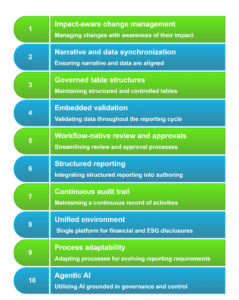
10 Essential Features Every Disclosure Management Platform Must Have
Below is a concise executive checklist. These capabilities are no longer differentiators — they are requirements.
How EcoActive Redefines Disclosure Management for Finance & ESG
Built Around the Reporting Cycle — Not the Document
EcoActive is designed with a different premise:
Reporting cycles are dynamic.
Late changes are inevitable.
Complexity must be absorbed by the system — not the team.
Rather than starting by adding “AI features” to an older model, EcoActive begins by mapping the moments that create the most stress and time loss in real reporting cycles:
- Changes that ripple across a report without full visibility
- Tables that shift shape and trigger downstream rework
- Reviews that turn into overhead instead of control
- Validations and tagging that arrive late, when fixes are expensive
- Audit support that gets assembled after the fact
From that foundation, EcoActive integrates Agentic AI in a disciplined way — grounded in governance, traceability, and control.
The AI is not designed to generate filings or introduce black-box edits. Instead, it reduces manual work and surfaces signals teams can rely on — where workflow is stalled, where risk may be building, and what is ready.
EcoActive addresses these realities through integrated architecture rather than layering automation onto a document-centric system.
Impact-Aware Change Handling
EcoActive surfaces the impact of changes across the report.
By reducing unseen ripple effects, it helps minimize late-cycle rework and supports clearer explanations of what changed and what it affected.
Narrative + Numbers That Stay Synchronized
EcoActive keeps narrative disclosures and numbers aligned throughout the reporting cycle.
This reduces silent drift between commentary and data and increases confidence in each version.
Tables as Governed Objects
Tables are treated as governed elements within the process.
This supports stable outputs across drafts and reduces the need for constant manual oversight when tables evolve mid-cycle.
Embedded Validations (Always On)
Validation is embedded directly into the workflow.
Issues are surfaced earlier rather than discovered at the deadline, reducing expensive last-minute corrections.
Workflow-Native Reviews
Reviews remain part of the system instead of moving into informal channels.
This supports clearer ownership and reduces repeated review cycles that add effort without strengthening control.
XBRL as a By-Product of Authoring (Powered by Ez-XBRL)
Structured digital reporting powered by Ez-XBRL is integrated into the authoring process.
XBRL is not treated as a separate end-stage activity, helping reduce late tagging effort and structural rework.
Audit-Ready Evidence Captured as You Go
Audit support is captured throughout the reporting cycle rather than assembled afterward.
This supports cleaner audits without post-cycle scrambling.
Agentic AI Grounded in Governance
EcoActive’s Agentic AI is grounded in governance, traceability, and control.
It does not generate filings or introduce black-box edits.
Instead, it reduces manual work and surfaces signals teams can rely on:
- Where things are stuck
- Where risk may be building
- What is ready
The objective is not to make teams work harder or faster.
It is to make the reporting process feel controlled again.
Disclosure Management Platform Evaluation Checklist (2026)
| Capability | Traditional Software | EcoActive |
| Impact-aware change visibility | ✗ | ✓ |
| Narrative and numbers synchronized | ✓ (manual alignment) | ✓ (built-in synchronization) |
| Tables governed as structured elements | ✗ | ✓ |
| Embedded, always-on validation | ✗ (end-stage validation) | ✓ |
| Workflow-native reviews within system | ✗ (email-dependent) | ✓ |
| Structured reporting integrated into authoring | ✗ (post-drafting tagging) | ✓ |
| Audit evidence captured during the cycle | ✗ (assembled after completion) | ✓ |
| Agentic AI grounded in governance | ✗ | ✓ |
| Ability to surface where workflow is stalled | ✗ | ✓ |
| Designed around the reporting cycle —
not just the document |
✗ | ✓ |
Ready to Strengthen Your Disclosure Process for 2026?
If your current disclosure management process still relies on manual oversight to manage late-cycle change, it may be time to reassess.
EcoActive is designed to help Finance, ESG, audit, and reporting teams regain control — especially when reporting cycles become complex, compressed, and highly scrutinized.
If you would like to see EcoActive in Action, schedule a conversation with our team.
Because in 2026, disclosure management should not feel fragile.
It should feel controlled.