

EcoActive for EU Taxonomy
Simplify Your EU Taxonomy Compliance Journey with EcoActive. Navigate the complexities of the EU Taxonomy effortlessly.
The EU Taxonomy Challenge
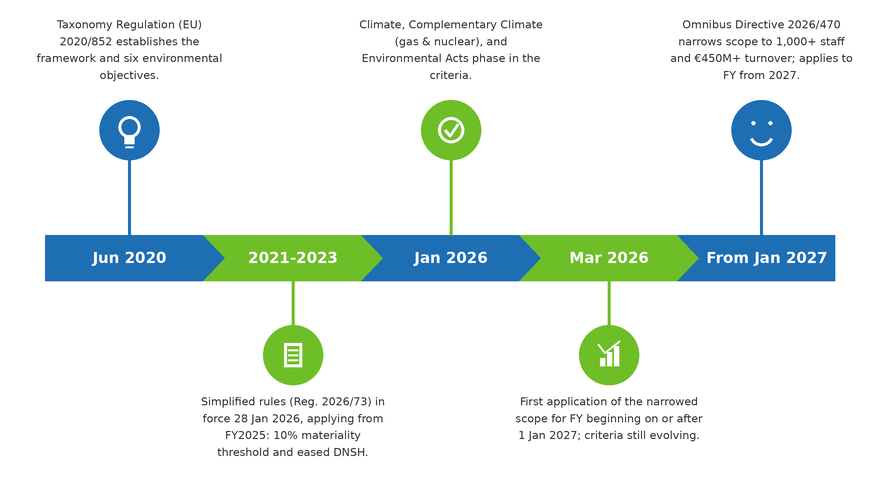
The EU Taxonomy Regulation (Regulation (EU) 2020/852) is a European Union framework that standardises the criteria for environmentally sustainable economic activities. As a science-based transparency tool, it creates a common definition of what counts as a “green” or “sustainable” activity — helping direct private investment toward the transition to a climate-neutral economy by 2050, and protecting investors from greenwashing.
For businesses in scope, the Taxonomy means classifying economic activities against detailed technical screening criteria, applying the Do No Significant Harm (DNSH) tests, collecting extensive data, and integrating sustainability reporting with financial reporting — often across systems that were never built to do this together.
What changed recently. Following the EU’s Omnibus simplification package, the reporting rules were streamlined and the mandatory scope narrowed — so the “full effect in 2024” framing no longer holds. The current position is set out in the box below and should replace any fixed 2024 date on the page.
The EU Taxonomy Today
- Simplified reporting rules. Commission Delegated Regulation (EU) 2026/73, published in the Official Journal on 8 January 2026, simplifies EU Taxonomy reporting by introducing materiality thresholds, streamlined disclosure templates, and simplified DNSH criteria for certain activities. The Regulation entered into force on 28 January 2026 and applies from 1 January 2026, with transitional provisions allowing undertakings to continue applying the previous rules for the 2025 financial year.
- Narrower mandatory scope. As part of the EU Omnibus simplification package, the reporting scope for the EU Taxonomy and related sustainability reporting requirements has been revised to focus on larger organizations. Under the current framework, mandatory reporting will apply primarily to EU companies with more than 1,000 employees and net turnover exceeding €450 million, with phased implementation beginning for financial years starting on or after 1 January 2027. Organizations should continue monitoring regulatory developments as implementation progresses.
- Still evolving. The European Commission continues to refine the EU Taxonomy through updates to the technical screening criteria and delegated acts. Proposals published in March 2026 sought to further simplify the usability of the criteria, reflecting the ongoing evolution of the framework.
The EU Taxonomy regulation creates a clear framework for the concept of sustainability, precisely defining when a company or enterprise is operating sustainably or environmentally friendly. Companies that meet these standards stand out positively compared to their competitors and should benefit from higher investments. The legislation aims to reward and promote environmentally friendly business practices and technologies.
- Climate change mitigation
- Climate change adaptation
- Sustainable use and protection of water and marine resources
- Transition to a circular economy
- Pollution prevention and control
- Protection and restoration of biodiversity and ecosystems
To be classified as a sustainable economic activity according to the EU Taxonomy regulation, a company must not only contribute to at least one environmental objective but also must not violate the remaining ones. An activity aiming to mitigate climate change but simultaneously negatively affecting biodiversity cannot be classified as sustainable.
The classification of an economic activity in terms of sustainability is based on four criteria, which are derived from the previously mentioned environmental objectives
1. Contribution to Environmental
2. Do No Significant Harm (DNSH):
3. Minimum Safeguards:
4. Technical Screening Criteria:
In April 2021, the first details for the two environmental objectives of climate change mitigation and adaptation were released. Detailed information for the four remaining environmental objectives is expected to be updated regularly to reflect the current technological state of the art.
The EU Taxonomy thus serves as a comprehensive and dynamic tool that supports the transition towards a more sustainable and climate-resilient economy by providing clear and actionable guidelines for classifying and reporting sustainable economic activities.
What is the EU Taxonomy?
The Taxonomy is built on solid scientific foundations:
- Research by the EU’s Joint Research Centre.
- Reports of the EU Technical Expert Group on Sustainable Finance.
- Contributions from a panel of experts within the Platform on Sustainable Finance, an advisory body of the Commission.
The EU Taxonomy aims to accelerate sustainable investments and create a common language for defining what is ‘sustainable’, helping to protect private investors from greenwashing, and mitigating market fragmentation.
Why EcoActive?
EcoActive is an Agentic AI-powered Financial and Sustainability Disclosure Management platform that helps organisations manage EU Taxonomy reporting through governed workflows, connected data, evidence traceability, and audit-ready reporting.
EU Taxonomy alignment doesn’t have to sit apart from the rest of your reporting. Because financial and sustainability data, disclosures, and reporting workflows are managed within one platform, your Taxonomy KPIs are built from the same governed data as your financial statements. Agentic AI assists throughout the reporting workflow — identifying inconsistencies, surfacing missing evidence, and supporting review and validation — while your team stays in control of every approval.
Key Features
Key CapabilitiesActivity Mapping to Taxonomy Criteria
Turnover, CapEx and OpEx KPIs Connected to Financials
Structured Data Collection and Governed Review
Technical Screening and <br>DNSH Support
Integrated Inline <br>XBRL
Impact-Aware Change Management
Benefits for You
The features of EcoActive translate into tangible benefits for businesses striving to meet EU Taxonomy requirements:
Time Reclaimed
Accuracy and Consistenc
the report.
Confidence, Not Stress
Efficient Use of Resources
EcoActive is more than just a software solution—it’s a partner in your EU Taxonomy compliance journey. By leveraging our platform’s key features, businesses can not only meet the regulation’s requirements but also enhance their overall sustainability reporting and performance, paving the way for a more sustainable future.
How It Works?
Step 1: Onboarding & Scope Setup
Step 2: Structured Data Collection
Step 3: Screening & DNSH Assessment
Step 4: KPI & Report Assembly
Step 5: Governed Review & Approval
Step 6: Filing & Continuous Improvement
ESG Services Provided by the EcoActive Team
Maturity Assessment
Materiality Assessment
ESG Framework Selection
Data Collection and Validation
Disclosures and Report Generation
Policy Development
Strategy Planning and Training
Target Setting
Leverage the expertise of the EcoActive team to navigate the complexities of ESG reporting and compliance. Our dedicated services are designed to complement our ESG reporting platform, providing a holistic solution to meet your sustainability needs. Whether you’re looking to refine your strategy, enhance your reporting, or engage your team in your sustainability mission, EcoActive is here to support you every step of the way.
Discover how our ESG services can transform your sustainability efforts. Contact us today to learn more or to schedule a consultation.
EU Taxonomy FAQs Section
Our FAQ section is designed to address your most pressing questions about EU Taxonomy compliance and how EcoActive can streamline your sustainability reporting process.
For ease of navigation, this section features an accordion layout, allowing you to expand each question to view the answer.
The EU Taxonomy is a classification system that helps companies and investors identify “environmentally sustainable” economic activities to make sustainable investment decisions. It sets criteria for activities that contribute to environmental goals and meet minimum safeguards.
currently says “companies under the CSRD must report.” Update to reflect the narrowed scope — EU companies over 1,000 employees and €450M net turnover, first applying for financial years from 1 January 2027, with others able to report voluntarily.
EcoActive simplifies compliance with automated data collection, comprehensive reporting tools, and technical screening criteria compliance, ensuring accurate and efficient reporting.
Yes, EcoActive is designed to integrate seamlessly with your existing systems, providing a streamlined approach to data collection and reporting.
EcoActive provides comprehensive onboarding, training, and support to guide you through the sustainability reporting process, ensuring you meet compliance requirements effectively.
Our dedicated support team is always available to assist with any queries or further training needs, ensuring your continued success in sustainability reporting.
For further inquiries or detailed explanations, please contact our support team. With EcoActive, you’re not just getting a platform for EU Taxonomy compliance; you’re gaining a partner dedicated to simplifying and enhancing your sustainability reporting efforts.