

Singapore Climate Reporting Software
Simplify Singapore ESG Reporting with Agentic AI
Manage ESG data, evidence, reporting requirements, reviews, and disclosures within one governed environment while Agentic AI supports consistency and reporting coordination.
AI-Native Reporting for ISSB-Based Climate Disclosure Requirements
EcoActive helps Singapore-listed and large non-listed companies manage climate reporting within one governed environment. Connect GHG emissions, climate risks, scenario analysis, energy data, value chain information, metrics, targets, evidence, reviews, and final disclosures within an AI-native reporting process.
What Are Singapore’s Climate Reporting Requirements?
Singapore is implementing sustainability reporting through a climate-first, phased approach based on ISSB-aligned requirements. As of August 2026, reporting timelines depend on company type and, for listed companies, market capitalization.
Official source: ACRA sustainability reporting requirements and timeline
Singapore Climate Reporting Timeline
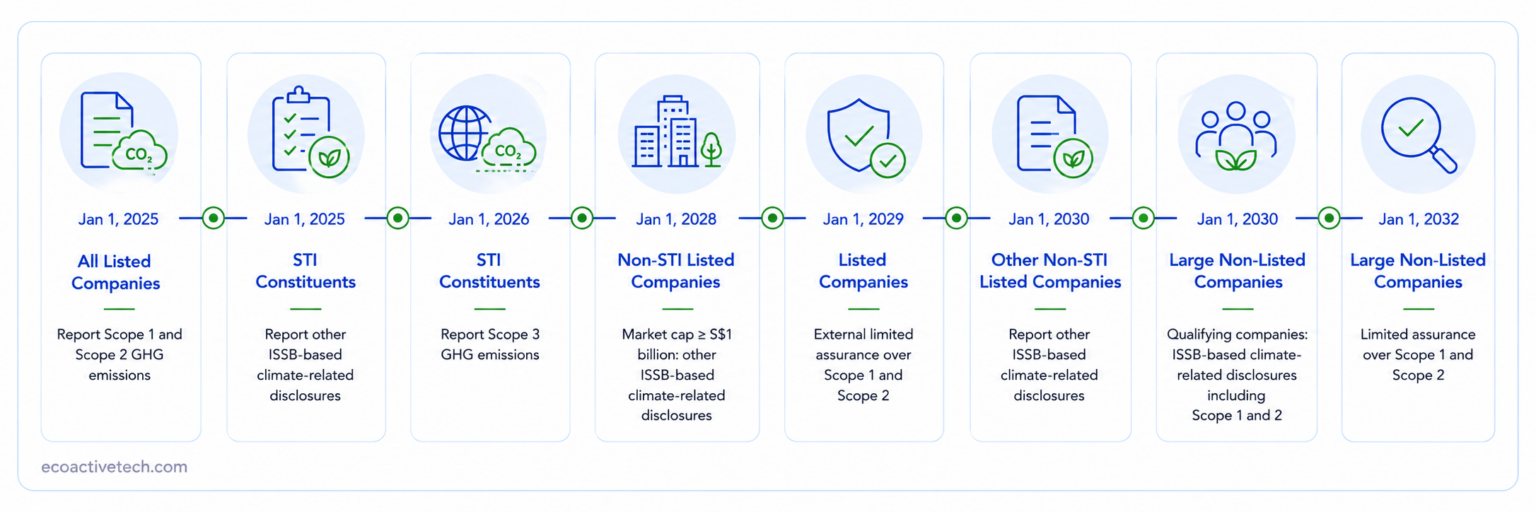
Who Needs to Report?
| Company Tier | Reporting Requirements |
|---|---|
| Listed Companies | All SGX-listed companies are within the sustainability reporting roadmap, with requirements phased by company tier. |
| Tier 1 — STI Constituents | Scope 1 and Scope 2 emissions from FY2025; other ISSB-based climate disclosures from FY2025; and Scope 3 emissions from FY2026. |
| Tier 2 — Non-STI Listed Companies With Market Capitalization of S$1 Billion or More | Already report Scope 1 and Scope 2 emissions and begin other ISSB-based climate-related disclosures from FY2028. |
| Tier 3 — Other Listed Companies | Scope 1 and Scope 2 emissions from FY2025 and other ISSB-based climate-related disclosures from FY2030. |
| Large Non-Listed Companies | Unless exempted, companies meeting both annual revenue of at least S$1 billion and total assets of at least S$500 million fall within the roadmap. ISSB-based climate reporting requirements begin from FY2030 under the revised timetable. |
What Must Companies Report?
GHG Emissions
- Scope 1 emissions
- Scope 2 emissions
- Scope 3 emissions where applicable
EcoActive’s Value Chain Management capability helps organize upstream and downstream information relevant to Scope 3 emissions and climate reporting.
Governance
How the organization oversees climate-related risks and opportunities.
Strategy
How climate risks and opportunities may affect the organization’s strategy, business model, and prospects.
Risk Management
How climate-related risks and opportunities are identified, assessed, prioritized, and monitored.
Metrics and Targets
The metrics and targets used to assess climate-related performance.
EcoActive’s ESG Target Management capability connects targets with KPIs, performance data, review, and reported disclosures.
HOW IT WORKS
Manage Singapore Climate Reporting in Seven Steps
1. Determine Your Reporting Tier
Establish whether the company is an STI constituent, Tier 2 listed company, Tier 3 listed company, or large non-listed company. The applicable requirements and implementation dates depend on this classification.
2. Reuse Existing Climate Information
Bring existing sustainability reports, climate disclosures, GHG inventories, policies, risk registers, energy records, targets, and supporting evidence into the reporting process.
3. Identify Climate-Related Risks and Opportunities
Structure physical and transition risks across relevant locations, operations, assets, and value chain relationships.
4. Perform Climate Scenario Analysis
Connect forward-looking climate assumptions with the organization’s actual exposure. EcoActive helps teams manage scenarios, pathways, assumptions, time horizons, physical risks, transition risks, business exposure, resilience conclusions, and evidence.
5. Manage Scope 1, Scope 2, and Scope 3 Information
Connect emissions with underlying activity and organizational data. Relevant value chain information can remain linked with suppliers, activities, evidence, methodology, and reporting requirements.
6. Prepare for External Assurance
Singapore requires external limited assurance over Scope 1 and Scope 2 emissions from FY2029 for listed companies and FY2032 for qualifying large non-listed companies. EcoActive helps maintain source data, calculation methodologies, evidence, reviews, approvals, and changes throughout the reporting process.
7. Generate the Report and Reuse Approved Information
Bring reviewed information together for reporting and retain the approved structure for future cycles.
2026 Update: Singapore Sustainability Disclosure Standards
Singapore continues to develop its local sustainability disclosure architecture. On July 27, 2026, ACRA’s Interim Sustainability Standards Committee launched a consultation on draft Singapore Sustainability Disclosure Standards. This is important for reporting teams because the local standards environment continues to develop alongside the existing ISSB-based climate reporting roadmap.
Official source: Singapore Sustainability Disclosure Standards consultation
Why EcoActive for Singapore Climate Reporting?
01
ISSB-Aligned Climate Reporting
Organize information around governance, strategy, risk management, metrics, targets, and climate resilience.
02
Scope 1–3 Emissions
Manage emissions information together with underlying activity data, methodology, evidence, and reviews.
03
Climate Scenario Analysis
Connect climate assumptions and scenarios with physical and transition risks.
04
Energy Management
Track energy consumption, energy mix, intensity, and supporting information.
05
Value Chain Connectivity
Maintain information required for Scope 3 and wider climate reporting across upstream and downstream activities.
06
Assurance Readiness
Build evidence, review, and traceability into reporting before assurance begins.
07
AI-Native Governance
Use AI to support repetitive reporting activities while keeping decisions and approvals under human control.
Frequently Asked Questions About Singapore Climate Reporting
Is climate reporting mandatory in Singapore?
Yes. Climate reporting requirements are being phased across listed companies and qualifying large non-listed companies, subject to the applicable reporting tier and exemptions.
What must all SGX-listed companies report from FY2025?
All listed companies are required to report Scope 1 and Scope 2 GHG emissions from FY2025.
When does Scope 3 reporting become mandatory?
Scope 3 emissions reporting is mandatory for STI constituents from FY2026. It remains voluntary until further notice for other listed companies under the current roadmap.
When do large non-listed companies begin climate reporting?
Qualifying large non-listed companies begin ISSB-based climate-related disclosures, including Scope 1 and Scope 2 emissions, from FY2030 unless an exemption applies.
Is external assurance required?
Yes. External limited assurance over Scope 1 and Scope 2 emissions begins from FY2029 for listed companies and FY2032 for qualifying large non-listed companies.
Build a Repeatable Singapore Climate Reporting Process
Connect emissions, climate risks, value chain data, energy, evidence, review, and reporting within one AI-native platform.