ESG reporting has become a continuous, high-stakes disclosure process involving multiple stakeholders, repeated review cycles, and formal approval checkpoints. As expectations around accuracy, consistency, and audit readiness increase, the challenge for reporting teams is no longer speed alone—it is maintaining clarity and control across the entire reporting lifecycle.
EcoActive addresses this challenge through an agentic AI–led ESG reporting process designed to support five critical capabilities: insight generation, role-based visualization, context-preserving summarization, continuous validation, and structured review and approval.
This blog explains how these capabilities work together within EcoActive to help disclosure management teams move from fragmented reporting to more controlled, approval-ready ESG disclosures.
What Agentic AI Means for Disclosure Management Teams
For disclosure management teams, agentic AI is not about replacing human judgment—it is about supporting judgment with context.
By operating across insights, validation status, summaries, visual views, and approvals, agentic AI helps teams prioritize attention, understand disclosure readiness, and move reports toward sign-off with fewer iterations. The result is greater control over both content and process, especially as reporting complexity continues to grow.
Challenges ESG Teams Face with Traditional Workflows
When ESG reporting workflows rely on simple automation or disconnected tools, teams often encounter challenges that are structural rather than operational. These issues are not caused by lack of effort, but by the absence of workflow-level intelligence.
- Insights arrive too late to influence decisions
Traditional workflow insights are typically generated after reporting is largely complete. This limits their usefulness for prioritization and often results in reactive fixes during review rather than proactive course correction. - Visualizations lack readiness context
Dashboards may show data points, but they do not reflect validation status, review progress, or unresolved issues. As a result, stakeholders struggle to understand whether disclosures are actually ready for approval. - Summaries drift from the approved version of record
When summarization is handled separately from validation and review, executive and board summaries can become misaligned with the latest approved disclosures—creating confusion and rework late in the process. - Validation issues surface during final review
In non-agentic workflows, validation is often performed at fixed checkpoints. This means inconsistencies and gaps are discovered during review or approval stages, when changes are most disruptive. - Review and approval cycles become fragmented
Without coordinated review mechanisms, approvals depend on manual follow-ups, offline comments, and version comparisons. This increases iteration cycles and weakens traceability of decisions.
EcoActive’s Agentic AI–Led ESG Reporting Process
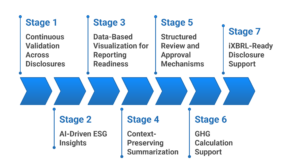
Stage 1: Continuous Validation Across Disclosures
In many reporting workflows, validation happens late in the cycle. EcoActive is designed to bring validation much earlier into the process, helping teams identify issues before review begins.
EcoActive supports continuous validation by:
- Providing validations early in the reporting lifecycle, not only at the end
- Linking metrics across notes and narratives to identify inconsistencies
- Detecting gaps or anomalies as disclosures evolve
By surfacing validation signals early, teams can resolve issues before they slow down reviews or approvals.
Stage 2: AI-Driven ESG Insights
EcoActive provides real-time insights based on current disclosure data, helping teams understand what needs attention as the reporting process progresses.
These insights help teams:
- Identify trends and changes as data is updated
- Detect areas that may require early correction or clarification
- Focus effort on sections most likely to impact disclosure quality
This enables teams to address potential issues earlier rather than discovering them during late-stage reviews.
Stage 3: Data-Based Visualization for Reporting Readiness
EcoActive supports real-time charts and visual views across ESG data, helping stakeholders quickly understand disclosure status.
Visualization capabilities help:
- Provide real-time charts for different types of ESG data
- Highlight readiness, open issues, and validation status
- Give teams and reviewers a clear view of reporting progress
These visual views help stakeholders quickly understand where the reporting process stands.
Stage 4: Context-Preserving Summarization for Stakeholders
Summarization becomes more reliable when it is based on validated and review-ready data.
EcoActive supports AI-assisted summarization that:
- Generates summaries using validated disclosure data
- Maintains context and alignment with the latest content
- Supports executive and internal review use cases
Because summaries are based on validated data, they remain aligned with the latest version of the disclosure.
Stage 5: Structured Review and Approval Mechanisms
EcoActive supports structured review and approval workflows designed to bring greater clarity and traceability to ESG disclosures.
The platform helps teams:
- Assign reviewers and manage approval stages
- Track comments, changes, and resolutions
- Provide visibility into outstanding issues before sign-off
- Maintain traceability throughout the approval process
Stage 6: GHG Calculation Support
EcoActive supports the use of GHG calculation tools within the reporting workflow, helping teams review and assess emissions data as part of the disclosure process.
This stage helps teams:
- Review emissions calculations alongside reported disclosures
- Assess consistency across related emissions data points
- Support internal checks during validation and review stages
By integrating GHG calculation support into the workflow, teams can address emissions-related questions earlier and with greater clarity.
Stage 7: iXBRL-Ready Disclosure Support
EcoActive supports iXBRL-ready ESG disclosures, including structured review of notes, as part of the reporting and approval process.
This stage helps teams:
- Prepare disclosures in formats aligned with iXBRL requirements
- Review structured notes alongside reported data
- Maintain consistency between narrative content and structured outputs
Supporting iXBRL readiness as a distinct stage helps teams prepare disclosures that are better aligned with digital reporting expectations.
These mechanisms help teams move toward approval with greater confidence and control.
Why a Workflow-Led Approach Matters
When insights, visualization, summarization, validation, and approvals are managed in isolation, ESG reporting becomes reactive and difficult to control. EcoActive’s agentic AI–led process brings these capabilities together into a coordinated workflow—helping teams reduce friction, improve clarity, and strengthen disclosure outcomes.
Rather than accelerating individual tasks, the focus is on making the entire reporting process more predictable, reviewable, and approval-ready.
Conclusion: From Fragmented Reporting to Controlled Disclosure
As ESG reporting expectations continue to rise, organizations need more than faster tools. They need processes that support insight, clarity, validation, and confident sign-off.
EcoActive’s agentic AI–led ESG reporting process is designed to meet this need—helping disclosure management teams manage complexity with greater control, fewer late-stage surprises, and stronger review confidence.
If you are looking to strengthen ESG insights, improve validation, streamline reviews, and bring greater structure to approvals, explore how EcoActive supports agentic ESG reporting workflows.
Request a demo to see the process in action.