Many disclosure management environments are still built around a central premise: produce the document.
That approach functioned when reporting cycles were slower and more sequential. Today, reporting is more interconnected and more scrutinized.
Finance and sustainability reporting increasingly converge. Oversight has intensified. Timelines are compressed. Tolerance for manual correction has declined.
While reporting outputs may appear refined, the process behind them often remains heavy. Reconciliation efforts expand. Reviews are repeated. Late adjustments create downstream disruption. Supporting materials are gathered under pressure.
Document-centric systems assume relative stability. They rely on staged reviews, milestone validations, and end-of-cycle consolidation. When change occurs late — after sections have been reviewed or approvals assumed complete — strain increases.
A number shifts.
A table is modified.
A tagging issue surfaces near submission.
Impact is not always visible. Teams must trace implications manually. Re-approval may be necessary, but identifying where and why takes effort. Confidence becomes dependent on coordination rather than structure.
Under scrutiny, attention turns to defensibility:
What changed?
What else did it influence?
Who reviewed the update?
Was anything overlooked?
When systems cannot respond clearly, assurance shifts from platform control to manual reconstruction.
The challenge is architectural.
EcoActive’s Reporting-Cycle Architecture
EcoActive is structured in response to this architectural gap.
Rather than organizing disclosure management around documents, EcoActive is designed around the reporting cycle itself — the flow of information from initial input through change, validation, review, approval, and structured output.
Reporting is treated as an evolving process, not a static artifact.
Instead of layering workflow onto files, the reporting cycle becomes the foundation. Documents emerge from a governed process rather than serving as the organizing center.
Teams increasingly seek a clearer progression from incoming data to report-ready output, followed by focused review and sign-off. That progression must remain stable even as information changes.
Within EcoActive’s reporting-cycle architecture:
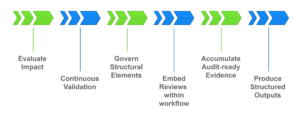
- Changes are evaluated for impact as part of normal operation
- Validation operates throughout the reporting cycle rather than only at checkpoints
- Structural elements such as tables are governed deliberately
- Reviews remain embedded within workflow with defined ownership
- Audit-ready evidence accumulates during the reporting cycle
- Structured outputs such as XBRL arise from controlled authoring
These elements directly address the friction observed in document-first systems.
Managing Change Without Destabilizing the Cycle
Late adjustments are not rare exceptions in modern reporting — they are expected.
Risk emerges when systems are not designed to manage them structurally.
In a reporting-cycle architecture, updates are assessed within context. Their implications are surfaced without relying solely on manual tracing. Where prior approvals are affected, that becomes visible.
This clarity supports defensibility when reporting is under scrutiny.
Change does not automatically escalate into uncertainty. It remains contained within a governed process.
Validation Embedded in the Reporting Flow
When validation is deferred to milestones or final checks, issues surface at the most expensive moment.
Embedding validation within the reporting flow shifts that pattern. Instead of discovering inconsistencies late, the process addresses them as work progresses.
Tagging and structured preparation do not become last-stage activities. They remain integrated with authoring.
This limits avoidable rework and reduces dependence on end-stage correction.
Governing Structural Components
Tables and disclosures are not merely formatted sections of a document. They are structural components of the reporting cycle.
When their configuration changes, downstream implications must remain visible.
Within a reporting-cycle design, these elements are managed deliberately. Narrative and numerical components remain aligned as part of the same controlled process.
Structure is governed, not inferred.
Reviews and Evidence Within the Reporting Cycle
In many environments, reviews expand late in the process when adjustments affect earlier approvals. Supporting materials are then assembled retrospectively.
A reporting-cycle approach keeps review embedded within workflow, maintaining ownership throughout.
Audit-ready evidence is captured during the reporting cycle itself.
When explanation is required, it is available within the system rather than reconstructed afterward.
AI Within Governance Boundaries
Technology can assist the reporting cycle, but it does not replace control.
Within EcoActive’s framework, AI operates inside governance and traceability. Its role is to reduce repetitive manual effort and highlight workflow and risk signals.
Automation supports discipline rather than bypassing it.
Control, Predictability, and Reporting Confidence
As reporting becomes more interconnected, the assumption of document stability becomes less sustainable.
Architectures built around the reporting cycle assume change as a constant.
When impact remains visible, validation operates continuously, approvals stay connected to underlying updates, and evidence is retained throughout the cycle, reporting becomes more predictable.
EcoActive reflects this reporting-cycle orientation.
The outcome is not only improved output, but a reporting process delivered with control, confidence, and quality by default.
The shift is not incremental.
It is architectural.
If you are rethinking how your disclosure process is structured, schedule a demo to review EcoActive’s reporting cycle based approach.