The Problem Finance Teams Know Well
It is day 87 of the annual report cycle. The auditors have changed the revenue figure. That single number now needs to be corrected across the primary financial statements, the notes to financials, and management commentary — with no automated way to find every instance. Three weeks earlier the same team was managing taxonomy extension conflicts. Two weeks before that, a last-minute validation error nearly delayed submission.
These are not isolated incidents. They are the recurring consequences of managing a complex, multi-party disclosure process without a governed platform built for it. ESEF (European Single Electronic Format) is routinely underestimated because it sounds like a formatting requirement. It is not. It is a disclosure management challenge — and the teams that manage it well do so because their process is governed, not because their people work harder.
EcoActive is an AI-native Financial Disclosure Management platform built specifically for ESEF reporting. Prepare IFRS financial statements, produce narratives, format and design the report layout, manage Inline XBRL tagging, govern multi-party review, and produce ESMA-compliant, audit-ready digital filings — all in one connected environment. Every change tracked. Every output consistent. No late-cycle surprises.
What ESEF Reporting Demands
- Structured data collection and consolidation: financial data arrives from multiple sources — Excel models, ERP systems, and financial close platforms. It needs to be brought together, validated, and maintained as a single governed dataset that drives every section of the report
- IFRS-driven reporting structure: the applicable IFRS accounting standards determine what must be disclosed, how it must be presented, and what level of detail the notes must contain. The report must be structured to reflect those requirements accurately and consistently
- Data flowing into statements and narratives: the same underlying figures must flow through primary financial statements, comparative periods, notes to financials, and management commentary — without manual re-entry or disconnected copies that drift out of sync during the reporting cycle
- Complete traceability back to source: every figure in the published report must be traceable back to its source data. Auditors and regulators need to follow the chain without encountering broken links, unexplained adjustments, or version mismatches
- Governed multi-party review: the authoring, review, and sign-off process spans finance teams, legal counsel, external auditors, and board approval. Each stage requires structured ownership, tracked actions, and a complete audit trail — not email chains
- ESMA-compliant digital output as an outcome: the annual report must be published as an ESMA-validated XHTML file with embedded Inline XBRL. That digital output should be a natural consequence of a well-governed disclosure process — not a separate technical exercise bolted on at the end
Where Late-Cycle Changes Break the Reporting Process
A revenue change in the final weeks of the reporting cycle does not affect just one line. It affects the primary statements, the comparative figures, the notes that reference it, and the management commentary that discusses it. A data discrepancy discovered close to submission requires changes that cascade across every section of the report. A review comment that arrives after board sign-off needs to be tracked, actioned, and re-approved — or it creates an audit trail gap.
- A value changes in week ten. The finance team updates the primary statement. Without a connected system, every note, every commentary paragraph, and every cross-reference that cites that figure needs to be found and updated manually.
- An auditor revision arrives on day 89. It affects a figure referenced in fourteen places. Identifying every instance and confirming each is updated is a manual process with no guarantee of completeness.
- A data gap is discovered close to submission. A required disclosure is missing or incomplete because no one had visibility into what the report structure demanded from each data owner. There is no time to fix it properly.
- Review and approval happen in email. Reconstructing who approved which version, and when, becomes difficult when the auditor or regulator asks for the audit trail.
How EcoActive Governs the Reporting Process
EcoActive manages the full ESEF annual report workflow in one governed environment — from data collection through to ESMA-compliant digital filing. Built using field-proven and patented automation techniques and driven by Agentic AI, finance teams, legal counsel, external auditors, and board sign-off all work within the same platform, with structured workflows, role-based access, and a complete audit trail throughout.
Components |
How EcoActive governs |
| End-to-end disclosure preparation | Financial data, narratives, financial tables, validations, and XHTML outputs are coordinated in one environment throughout the reporting cycle.
Primary statements, notes to financials, and management commentary all draw from the same governed data — no manual re-entry, no version conflicts. |
| Narrative and numbers aligned | Financial data and narrative disclosures remain synchronized throughout report preparation.
Every figure is connected to its source. When a value changes, every narrative section that references it is flagged automatically — nothing is missed. |
| Governed tables and structured outputs | Financial tables behave as governed objects with locked structures, controlled edits, and tracked changes.
Structural consistency is enforced throughout the reporting cycle, so tables in the published report match what the finance team approved. |
| Impact-aware change management | When an auditor changes a number late in the cycle, every cross-reference across the full report is flagged automatically.
The team sees exactly what needs to be reviewed. No manual search. No missed instances. |
| Workflow-native reviews | Targeted review workflows assign ownership, manage approvals, and monitor completion status across finance, legal, external auditors, and board sign-off.
Every action is tracked and time-stamped. Review loops are reduced and accountability is clear throughout. |
| Continuous validation | Embedded checks run throughout the reporting cycle — not as a final gate at submission.
Data inconsistencies, narrative misalignments, missing disclosures, and structural issues surface while there is still time to resolve them, not when the deadline has passed. |
| Digital-ready filing output | The final ESEF filing — XHTML with Inline XBRL — is generated directly from the governed, validated report environment.
Powered by Ez-XBRL for package validation and creation. What the team reviewed and approved is exactly what ESMA receives. |
How the EcoActive Platform Works
EcoActive is a financial disclosure management platform that governs the entire annual report process — from the moment financial data enters the system to the moment the ESMA-compliant filing leaves it. Every capability is built around how finance teams actually work.
What EcoActive manages |
How it works |
| Data ingestion from any source | Financial data is imported directly from Excel models, ERP systems, and financial close platforms. EcoActive maintains a single governed dataset from the point of ingestion — eliminating manual re-keying and the version conflicts that come with it. |
| IFRS standards and taxonomy driving the report | The applicable IFRS accounting standards and ESEF taxonomy define the structure, content requirements, and presentation rules of the annual report. EcoActive uses those standards to drive what data is collected, how it is presented, and where disclosures must appear — so teams work within the right framework from the start, not at the end. |
| Data flowing into statements and narratives | Once data is in the system, it flows into the primary financial statements, comparative periods, notes to financials, and management commentary from a single source. A figure does not exist in multiple places. It exists once, referenced everywhere — and when it changes, every reference updates. |
| Full traceability to source | Every figure in the published report traces back to its source data without complicated data linking or broken references. Auditors can follow the chain from the published XHTML output back to the original data entry point. No unexplained adjustments. No version mismatches. |
| Agentic AI orchestrating the process | EcoActive’s Agentic AI actively orchestrates the reporting workflow — monitoring data completeness, flagging inconsistencies between figures and narrative sections, coordinating review assignments, and surfacing issues that need attention before they become filing risks. Teams are guided through the process rather than managing it manually. |
| Governed review and compliant output | Workflow-native reviews assign ownership and track every approval action with a time-stamped audit trail. When the report is complete and approved, the ESMA-compliant XHTML filing with embedded Inline XBRL is generated directly from the governed environment, powered by Ez-XBRL — not re-keyed or rebuilt for submission. |
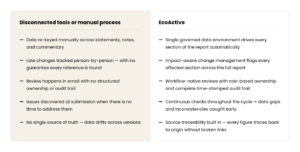
Traditional Approaches vs. a Governed Disclosure Platform
What You Gain
If you’re a |
What EcoActive delivers |
| CFO | No late-cycle filing crises. Impact-aware change management means a revision on day 89 does not create an inconsistent filing. Ez-XBRL powers package validation. Confident sign-off backed by a complete audit trail. Future-ready for evolving EU digital reporting requirements. |
| CEO | Credible, investor-grade annual report disclosures. Reputational risk is reduced when financial narratives are internally consistent and governed. Board sign-off supported by continuous validation throughout the cycle. |
| Finance Reporting Team | The reporting cycle is governed, not improvised. Data flows from source into every section automatically. Changes are tracked across the full report. Review workflows have owners and deadlines. The audit trail is built throughout the process — not reconstructed at the end. |
| Compliance & Legal |
A complete, time-stamped audit trail from first draft to final filing. Role-based access ensures only authorized reviewers approve at each stage. The governed process is defensible to regulators and auditors. |
Your 2026 Action Checklist for Finance Teams
ESEF compliance is an annual obligation with increasing technical expectations. These are the questions finance and compliance teams should be asking about their current process.
- Audit your change management process: when a value changes late in the cycle, does your current system automatically identify every section that references it — or does the team search manually?
- Review your last ESMA filing outcomes: if your most recent filing generated warnings or required re-submission, does your current approach prevent recurrence — or only detect issues at submission?
- Assess your data governance: is there a single source of truth driving your annual report, or are figures maintained across multiple systems and reconciled manually before submission?
- Evaluate your review and audit trail: if a regulator requested a complete record of who reviewed and approved each section of your report, could you produce it without reconstructing it from email?
- Assess your reporting architecture: as EU digital reporting requirements continue to evolve, does your current approach have the governance structure to scale — or will complexity increase with each reporting cycle?
Conclusion
ESEF compliance is not a once-a-year formatting task. It is a year-round disclosure management process — one that involves dozens of contributors, multiple review rounds, late-cycle changes, taxonomy management, and a digital filing requirement that grows more demanding each year.
EcoActive governs that process from end to end. Financial data collection from any source, IFRS-driven report authoring, narrative alignment, governed table management, Agentic AI orchestration, workflow-native reviews, continuous validation, and ESMA-compliant digital filing — all in one connected platform. Impact-aware change management means late revisions do not create inconsistent filings. Every change is tracked. Every output is consistent. No year-end crises.