

CSRD Reporting Software
End-to-End AI-Native CSRD Reporting Software with Agentic AI
From Double Materiality to an Assurance-Ready CSRD Report
EcoActive is an AI-native, end-to-end ESG disclosure management platform with Agentic AI capabilities that support teams across the CSRD reporting lifecycle. The platform brings CSRD requirements, double materiality, data collection, value chain information, energy and climate-related assessments, governed workflows, assurance preparation, and report generation into one connected environment.
Agentic AI helps teams identify issues, assess the impact of changes, support validation, and surface areas that require review, while governed workflows and human oversight maintain control, traceability, and assurance readiness throughout the reporting process.
Reuse Information From Previous Reports and Existing Sources
Identify What is
Missing
Automate Repeatable
Work
Maintain Human Oversight
Prepare An Audit-Ready Report
Establish the foundation for the next reporting cycle
What Is CSRD?
The Corporate Sustainability Reporting Directive is the European Union’s sustainability reporting legislation.
Companies within scope must prepare a sustainability statement using the European Sustainability Reporting Standards. CSRD applies double materiality: companies report how their activities affect people and the environment, and how sustainability matters affect their financial position, performance, and development.
CSRD reporting requires more than producing a final document. Companies need a repeatable process for determining material information, collecting data, documenting decisions, applying controls, managing reviews, and supporting limited assurance.
What Changed Under the CSRD Omnibus?
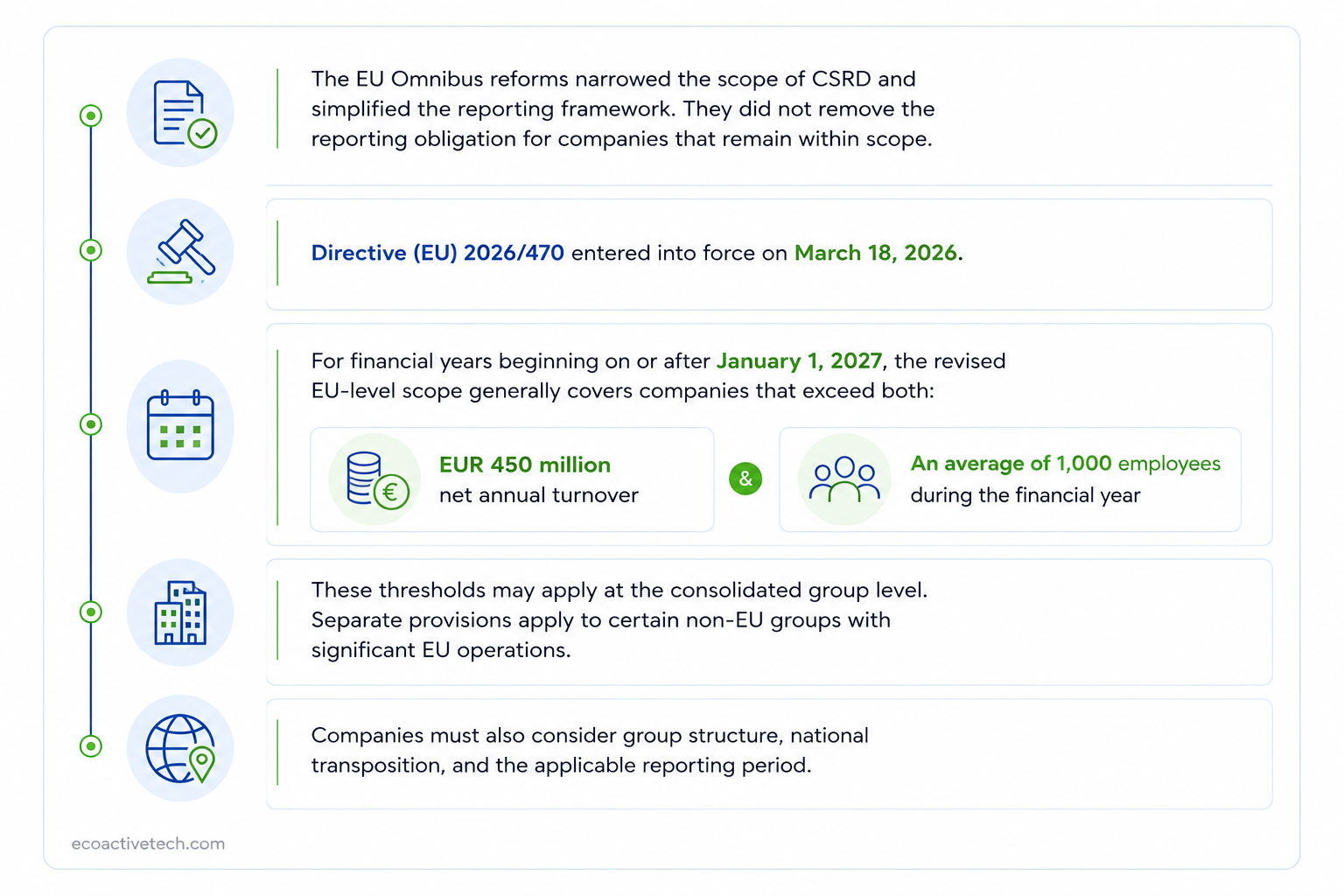
CSRD After the Omnibus
| CSRD Area | Current Position |
|---|---|
| Scope from FY 2027 | More than 1,000 employees and over EUR 450 million net turnover |
| Reporting Standards | Revised ESRS adopted in July 2026 |
| Double Materiality | Retained |
| Value Chain Reporting | Required where material, with protections for smaller value chain companies |
| Assurance | Limited assurance retained |
| Reasonable Assurance | Planned mandatory progression removed |
| National Implementation | Member State transposition must be considered |
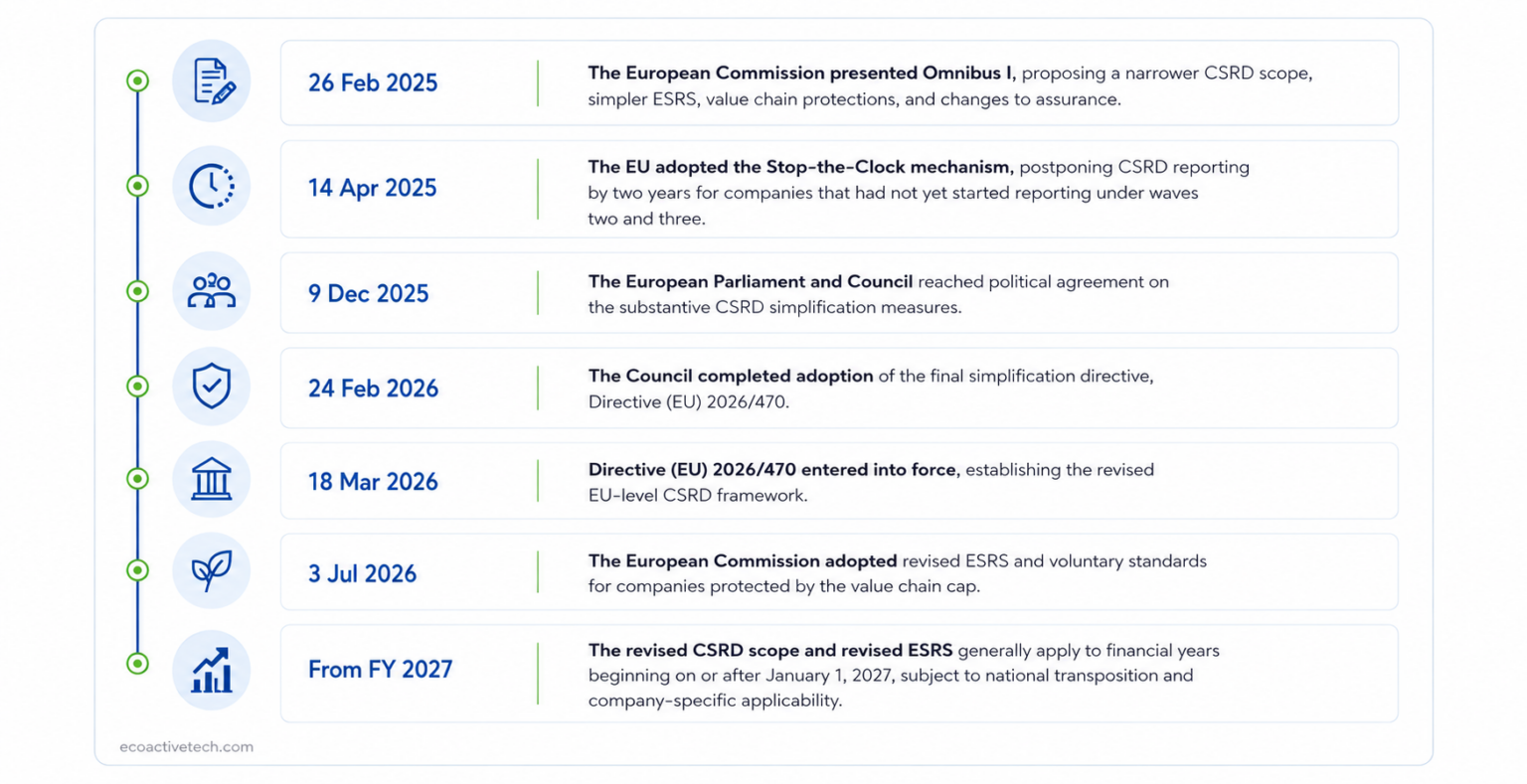
On July 3, 2026, the European Commission adopted revised European Sustainability Reporting Standards (ESRS). The revised standards apply from financial year 2027, with early adoption for financial year 2026 permitted once the delegated act becomes legally effective.
Reference: EFRAG Revised ESRS Knowledge Hub
CSRD Omnibus Timeline
HOW IT WORKS
Complete CSRD Reporting in Eight Steps
EcoActive connects the principal requirements and activities involved in CSRD reporting within one AI-native platform. Teams can determine what applies, reuse existing information, complete missing data, manage value chain, energy, climate, and other sustainability information, coordinate reviews, and prepare the final report.
1. Establish Your CSRD Reporting Scope
CSRD applicability depends on company size, group structure, reporting period, jurisdiction, and national transposition. EcoActive helps establish the reporting period, entities, operating locations, reporting boundaries, and applicable requirements, creating a consistent foundation for the reporting process.
2. Start With Information You Already Have
A new reporting cycle should not begin with an empty template. EcoActive allows teams to bring forward relevant information from previous sustainability and annual reports, policies, questionnaires, spreadsheets, ERP and connected systems, emissions records, prior-year disclosures, and supporting evidence. Users can apply native AI to identify information that may be reused, updated, or completed.
3. Complete Double Materiality
Double materiality determines which sustainability matters and ESRS disclosures are material. EcoActive provides a structured workflow covering impact and financial materiality, stakeholder inputs, impacts, risks and opportunities, scoring, thresholds, evidence, reviews, approvals, and final conclusions.
4. Determine Disclosure Requirements and Identify Gaps
EcoActive connects confirmed material topics with applicable ESRS disclosure requirements and compares them with available reports, policies, data, and evidence. Teams can see what is available, reusable, incomplete, or missing. Users can apply native AI to support the initial gap assessment, with conclusions remaining subject to human review.
5. Automate Tasks and Reporting Workflows
- GHG Emissions Calculator: EcoActive’s GHG Calculator helps organizations quantify and manage Scope 1, Scope 2, and Scope 3 emissions using GHG Protocol-aligned accounting. It connects emissions information with energy and value chain data, targets, supporting evidence, review, and applicable CSRD climate disclosures within the wider reporting process.
- Value Chain Management: EcoActive helps organizations identify, organize, and manage sustainability-related information across their upstream and downstream value chain. It connects value chain activities with impacts, risks and opportunities, ESG data, relevant Scope 3 information, supporting evidence, and disclosure requirements. This helps reporting teams understand where material sustainability matters arise and how they affect CSRD reporting.
- Energy Management: EcoActive helps organizations collect, classify, monitor, and report energy consumption and energy mix across their operations. Energy information remains connected with GHG emissions, sustainability targets, analytics, supporting evidence, and disclosure requirements, creating a consistent and traceable view throughout the reporting cycle
- Climate Scenario Analysis: EcoActive helps organizations assess how different plausible climate futures could affect operations, assets, the value chain, financial performance, strategy, and the business model. It connects climate scenarios with physical and transition risks, assumptions, time horizons, business exposure, supporting evidence, resilience conclusions, and disclosure within a governed process.
6. Connect Value Chain Data to Disclosure
EcoActive automates repeatable activities across data collection, task creation, workflow routing, deadline monitoring, recurring reporting activities, validation, review, approval, and report preparation. Responsibilities remain clear across data owners, preparers, reviewers, and approvers.
7. Validate, Review, Analyze and Prepare for Assurance
EcoActive helps teams identify missing information, detect inconsistencies, review calculation issues, compare periods, explain material changes, attach evidence, resolve validation points, provide insights and complete reviews and approvals. A governed record of sources, changes, evidence, decisions, and approvals supports limited-assurance preparation
8. Generate the Report and Prepare for Next Year
Approved data, narrative disclosures, policies, targets, and supporting content move into a consistent sustainability statement. Applicable disclosures, comparative data, evidence, responsibilities, and report structure can then be carried into the next cycle, allowing teams to focus on what changed instead of starting again.
Automate the CSRD Process with Native AI and Agentic AI
EcoActive is built as an AI-native platform. Users can apply native AI to review previous reports, identify reusable information, support gap assessment, review policy coverage, support benchmarking, identify reporting watch points, and assist with report preparation.
Agentic AI supports coordination across connected reporting activities by surfacing pending actions, dependencies, and items requiring attention. AI-assisted outputs remain subject to human review. Materiality judgments, regulatory interpretation, reporting decisions, and final approvals remain with the responsible professionals.
The EcoActive AI Trust Centre brings transparency to AI-assisted work by showing where AI was used, who initiated it, what information was affected, and how the output was reviewed. This supports governed, human-in-the-loop use of AI throughout the CSRD reporting process.

Why Choose EcoActive for CSRD Reporting?
01
End-to-End Coverage
Manage reporting from scope assessment and double materiality through GHG calculation, value chain, energy and climate disclosures, assurance preparation, and report generation.
02
Reuse Instead of Rework
Start with existing reports, data, policies, questionnaires, and supporting evidence.
03
Connected Sustainability Information
Connect value chain activities, energy information, GHG emissions, climate risks, resilience, targets, evidence, and applicable disclosures within the wider CSRD process.
04
Automation Across the Process
Reduce manual data collection, task creation, follow-up, validation, review, and report preparation.
05
AI-Native Architecture
Use native AI and agentic AI within the governed reporting process.
06
Transparent AI Governance
Use the AI Trust Centre to understand where AI was used, who initiated it, what was affected, and how it was reviewed.
07
Human-in-The-Loop Governance
Keep interpretation, materiality decisions, reviews, and approvals with responsible professionals.
08
Audit Readiness From The Start
Maintain evidence, changes, comments, decisions, reviews, and approvals throughout the reporting cycle.
09
Year-to-Year Continuity
Carry forward applicable information and focus each reporting cycle on what changed.
Frequently Asked Questions About CSRD Reporting
What is CSRD reporting software?
CSRD reporting software helps companies manage double materiality, GHG calculations, ESRS disclosures, climate information, data, evidence, workflows, reviews, and report preparation within a structured environment.
Is CSRD still applicable after the Omnibus reforms?
Yes. The reforms narrowed scope, revised timelines, simplified ESRS, introduced value chain protections, and retained limited assurance.
Who must report under CSRD from 2027?
At EU level, CSRD generally applies from financial year 2027 to companies exceeding both EUR 450 million in net turnover and an average of 1,000 employees. Applicability can also depend on group structure, national transposition, and provisions for non-EU groups.
Does double materiality still apply?
Yes. Companies assess their impacts on people and the environment alongside the financial effects of sustainability-related risks and opportunities.
Does CSRD require a climate transition plan?
Where climate change is material, a company discloses its transition plan if it has one. If no plan is in place, it discloses that fact and indicates whether and when it expects to adopt one.
Is climate scenario analysis mandatory under CSRD?
Not as a universal method. It can support assessment of climate-related risks and resilience. If used, relevant information about scenarios, scope, assumptions, and timing is disclosed.
How does EcoActive manage value chain information for CSRD?
EcoActive connects relevant upstream and downstream activities with material impacts, risks and opportunities, ESG data, Scope 3 information, evidence, and disclosure requirements within a governed reporting process.
How does EcoActive connect energy information with CSRD reporting?
EcoActive organizes energy consumption and energy mix across operations and connects the information with GHG emissions, targets, analytics, evidence, and applicable disclosures.
How does EcoActive support climate scenario analysis?
EcoActive structures scenarios, assumptions, time horizons, physical and transition risks, business exposure, resilience conclusions, evidence, review, and disclosure connections within a governed environment.
Can EcoActive reuse information from previous reports?
Yes. Relevant information from previous reports, policies, questionnaires, spreadsheets, connected sources, and supporting evidence can be carried forward for review and approval.
How does EcoActive use AI for CSRD reporting?
Users can apply native AI to review previous reports, identify reusable information, support gap assessment, review policy coverage, and assist with report preparation. Agentic AI supports coordination while human users remain responsible for decisions and approvals.
Build a Repeatable CSRD Reporting Process
Bring CSRD requirements, data, value chain, energy and climate capabilities, people, controls, and report preparation together in one AI-native platform.
Reuse what you already have. Complete what is missing. Automate repeatable work. Maintain human accountability. Prepare an audit-ready report and begin the next reporting year without starting again.