The Financial Disclosure Process That Already Knows How You Operate
Imagine opening a new reporting cycle to find your financial statements already populated from your source data — in the format your team already uses. Notes to those statements are summarized and ready for review. The platform has surfaced what your organization disclosed in prior filings, identified what may need to be updated based on this year’s figures, and — where you’re entering new disclosure territory — surfaced how peer companies in your industry have handled comparable items. Your team’s role shifts from building the report to governing it.
That is what financial disclosure management looks like when Agentic AI and automation are built into the very fabric of the solution.
The Real Problem: The system your team is working around
Most finance teams approaching a new reporting cycle are working within a system that still places the full burden of institutional memory, narrative judgment, and cross-cycle continuity on the team itself. The platform provides a canvas. The team provides everything else.
In practice, that means:
- Financial statements built manually from source spreadsheets every cycle
- Notes to financial statements drafted from scratch, even when 80% is unchanged year-on-year
- New disclosure requirements researched and manually flagged for inclusion and insertion into the report
- XBRL tagging done towards the end of the cycle thereby increasing the risk
- Every change requires the gathering of audit evidence as reporting teams contend with late-stage time constraints, often after the report is largely complete
This isn’t really a people problem. Even the most capable teams can struggle when a 60–70 page financial report has to be managed in systems that simply aren’t built to handle that level of complexity—especially as today’s reporting expectations continue to evolve and demand more.
EcoActive’s unique approach to the financial reporting process
EcoActive understands this challenge. By applying Agentic AI and automation across each stage of the reporting cycle, it helps ensure your team’s judgment is focused on decisions that truly matter—while easing the effort involved in pulling together and managing recurring content.
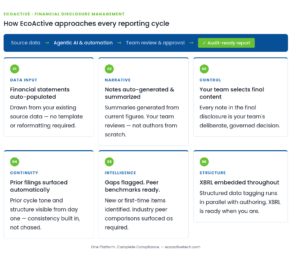
The result is a reporting cycle where your team spends less time building and more time governing — with every output traceable, every decision auditable, and every filing ready to withstand scrutiny.
How the reporting cycle changes in practice
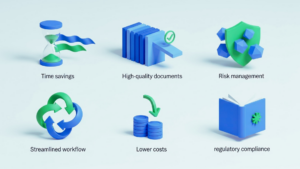
What You Gain You gain
- Time reclaimed across the cycle — Teams spend their hours on review, governance, and decision-making — not construction
- Consistent, defensible disclosures — Continuity of language, tone, and structure is built into the platform, not dependent on who ran last year’s report
- Proactive gap management — Missing or new disclosure items are flagged before they become a problem, not discovered at submission
- Reduced audit friction — Evidence is captured as the cycle progresses, eliminating the retrospective assembly that delays sign-off
- Lower cycle costs — Fewer late-stage vendor engagements, less rework, and no emergency XBRL conversions
- Regulatory confidence across jurisdictions — A single governed environment for financial and regulatory disclosures across markets
EcoActive: The only AI-native solution for every financial reporting cycle
EcoActive is purpose-built for finance and disclosure teams managing complex, multi-jurisdiction reporting — where accuracy, audit readiness, and regulatory confidence are the baseline, not the aspiration.
Schedule a demo to see the reporting-cycle approach in practice.