The Voluntary Sustainability Reporting Standard for SMEs (VSME) is a voluntary sustainability reporting framework specifically designed for micro, small, and medium-sized enterprises that are not listed and do not fall under the scope of the Corporate Sustainability Reporting Directive (CSRD). SMEs in this context are businesses typically smaller in scale, often defined by employee numbers and turnover limits, representing a significant part of the economy.
If you run a small or medium-sized business, you’ve likely heard about the growing need to report on your environmental, social, and governance (ESG) efforts. Investors, banks, and large clients seek clarity on your sustainability — yet this can feel overwhelming without guidance. The Voluntary Sustainability Reporting Standard for SMEs (VSME) is designed by the European Financial Reporting Advisory Group (EFRAG) to simplify this process for SMEs.
1. What is the VSME Standard?
a. Overview: Why VSME Was Needed and How It Connects with CSRD
The Voluntary Sustainability Reporting Standard for SMEs (VSME) is a new, voluntary reporting framework designed specifically for micro, small, and medium-sized enterprises that are not listed on stock exchanges and are therefore not required to report under the EU’s Corporate Sustainability Reporting Directive (CSRD). If you run a smaller business, reporting on your environmental, social, and governance (ESG) efforts is becoming more important – but it can feel complex and overwhelming, especially with limited resources.
That’s where the VSME comes in. Developed by the European Financial Reporting Advisory Group (EFRAG) at the request of the European Commission, the VSME helps smaller businesses respond to increasing demands for sustainability data from investors, banks, and large corporate clients – without the heavy compliance burden that bigger companies face under CSRD. It offers a simplified, modular approach, letting you choose the level of ESG reporting that fits your size and needs.
The VSME standard provides SMEs a practical way to demonstrate their sustainability commitment, improve access to finance, and prepare for evolving regulatory expectations – all while reducing fragmented and excessive ESG data requests from business partners.
Timeline and Current Status of the VSME Standard
- December 17, 2024: EFRAG published the final draft of the VSME standard, marking it ready for SMEs to adopt immediately for sustainability reporting. The official standard is accessible here.
- Throughout 2025: EFRAG has been actively promoting adoption via training workshops, support materials in multiple languages, helpful videos, and community engagement designed to simplify the reporting journey.
- July 30, 2025: The European Commission officially recommended the uptake of the VSME by SMEs, encouraging banks, investors, and large companies to base their ESG data requests on this standard – reducing confusion and compliance costs for smaller businesses.
- 2025-2026: Ongoing consultations, field testing, and development of guidance and digital tools are underway to make reporting with the VSME even easier and more effective.
- From 2026 onward: The VSME may be formally adopted as a delegated act under EU law, embedding it firmly within the sustainability reporting ecosystem, and providing a clear, stable framework for SMEs.
How VSME Reporting Standard differs from CSRD
While the CSRD mandates detailed sustainability reporting mainly for large, listed companies, the VSME offers a voluntary and simplified reporting framework tailored specifically for non-listed SMEs outside the CSRD’s scope. It helps smaller businesses meet growing ESG information requests without the complexity or cost burdens of CSRD, offering a flexible entry point into sustainability reporting and preparation for future regulatory changes.
| Aspect | VSME | CSRD |
| Mandatory | No, voluntary | Yes, mandatory for large and listed companies |
| Applicability | Non-listed micro, small, and medium enterprises | Large, listed companies and some medium businesses |
| Reporting Complexity | Simplified, modular Basic and Comprehensive modules | Detailed, comprehensive with sector-specific rules |
| Assurance Requirement | Not mandatory | Mandatory |
| Integration with Financial Reporting | Not required | Required |
| Scope | Core ESG topics, limited Scope 3 emissions | Extensive ESG data including all Scope emissions |
| Purpose | Reduce burden and fragmentation for SMEs | Ensure consistent sustainability disclosure across large firms |
b. Purpose of the VSME Standard
EFRAG introduced VSME to support SMEs in efficiently communicating sustainability performance and responding to frequent requests for ESG data from larger companies, financial institutions, and investors. The framework streamlines disclosures, reduces administrative burden, and empowers SMEs to manage and improve their sustainability as a strategic asset.
Benefits of the VSME Standard
- Provides a simplified, voluntary framework tailored specifically for micro, small, and medium-sized enterprises.
- Helps SMEs meet growing ESG data demands from investors, banks, and corporate clients without the complexity of CSRD.
- Reduces administrative and cost burdens by harmonizing and standardizing ESG information requests.
- Enhances SMEs’ access to sustainable finance by demonstrating transparent sustainability performance.
- Supports SMEs in building resilience and managing environmental and social risks.
- Enables SMEs to improve competitiveness and maintain strong relationships with larger business partners.
- Prepares SMEs to align with evolving regulatory requirements and stakeholder expectations over time.
c. Structure of the VSME Standard
The VSME Standard is designed with flexibility and proportionality in mind, divided into two modular components to accommodate the varied capacities and sustainability ambitions of SMEs. 1)The Basic Module serves as the foundation, focusing on essential sustainability disclosures that apply broadly to most SMEs, especially micro-enterprises. For SMEs facing more stakeholder demands or operating in sectors with higher sustainability risks, 2) the Comprehensive Module adds in-depth disclosures covering strategic, environmental, social, and governance aspects. This modular approach allows SMEs to tailor their reporting in line with their size, complexity, and stakeholder expectations, while maintaining consistency and comparability.
2. Scope of the VSME Standard
The VSME standard applies to unlisted SMEs in the EU enterprises with fewer than 250 employees, annual turnover not exceeding €50 million, or a balance sheet total not exceeding €43 million as per Directive 2013/34/EU. It is also available to micro-enterprises and, if desired, to any business outside CSRD scope. The VSME covers key ESG matters:
- Environmental: Energy use, GHG emissions, pollution, climate risks, biodiversity, and waste/water management
- Social: Workforce well-being, health/safety, human rights, diversity, training, labor rights
- Governance: Ethics, anti-corruption, board composition, remuneration, supply chain transparency
3. Detailed Disclosure Requirements of VSME
Each module offers structured disclosures grouped into ESG subtopics, with the “if applicable” principle ensuring that only relevant information is reported.
a. Basic Module
The Basic Module provides a solid foundation for SMEs new to sustainability reporting or facing initial ESG information requests. It covers approximately 50 essential data points including:
- General Information: Company structure, sector, size.
- Environmental: Core metrics such as energy consumption, Scope 1 & 2 greenhouse gas (GHG) emissions, pollution, and water usage.
- Social: Workforce indicators including employee numbers, training, fair wages, and health & safety.
- Governance: Key governance measures, including anti-corruption policies and any legal fines or penalties.
This module ensures transparency on key ESG aspects without overwhelming complexity.
b. Comprehensive Module
Designed for SMEs with more complex operations or higher stakeholder expectations, the Comprehensive Module builds on the Basic Module and includes around 100 additional data points:
- Materiality Assessment: A crucial step to identify which sustainability topics are most relevant.
- Strategy: Integration of sustainability into the business model and ESG strategy.
- Environmental: Detailed emissions data, including Scope 3 emissions, GHG reduction targets, and climate risk management plans.
- Social: Policies on labor standards, human rights due diligence, diversity, equity & inclusion initiatives.
- Governance: Expanded disclosures on board diversity, remuneration policies, risk management processes, and supply chain transparency.
This allows SMEs to provide greater depth and strategic insights into their sustainability efforts over time.
c. “If Applicable” Principle
Disclosures should only be made when they are relevant to the SME’s specific activities, sector, or impacts. Non-applicable requirements may be omitted without further explanation, ensuring reports are proportionate and focused.
Basic vs. Comprehensive Module Comparison
| Feature | Basic Module | Comprehensive Module |
| Purpose | Target approach for micro-undertakings; minimum reporting requirements for other SMEs. Provides essential ESG data points for foundational sustainability reporting. | Adds additional data points to those in Basic Module, typically requested by banks, investors, and corporate clients for deeper sustainability insights. |
| Composition | Disclosures B1 and B2 plus Basic Metrics (B3 to B11), totaling 11 mandatory disclosures. | Supplementary disclosures beyond B1-B11, adding approximately 9 more mandatory disclosures covering strategy, climate, human rights, governance, and supply chain. |
| Modularity | Can be used standalone or as a prerequisite foundation for Comprehensive reporting. | Must be used in addition to the Basic Module (completion of Basic Module is necessary). |
| Flexibility | Supports simplified reporting using proportionality and the “if applicable” principle. | Encourages detailed, narrative disclosures with qualitative and quantitative data, aligned with business-specific impacts and stakeholder needs. |
4. Reporting Principles for VSME
The VSME framework is based on key principles ensuring relevant, reliable, and practical sustainability reporting for SMEs:
- Relevance: Focus on sustainability information that matters most to your business and stakeholders.
- Reliability: Provide truthful, complete, and unbiased data.
- Comparability: Use consistent methods for year-on-year and peer comparisons.
- Understandability: Present information clearly and simply.
- Verifiability: Ensure reported data can be validated where needed.
- Proportionality: Align reporting effort with your SME’s size and resources.
- Stakeholder Engagement: Include relevant parties to improve report quality.
- Alignment with Financial Reporting: Where suitable, integrate sustainability disclosures with financial results.
- Modularity and Flexibility: Use Basic and Comprehensive modules to fit your capacity and goals.
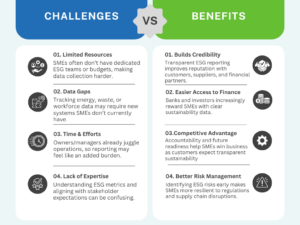
5. Challenges & Opportunities/Benefits
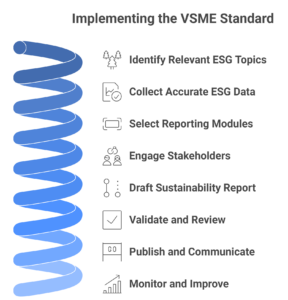
6. Step-by-Step Guide to Implementing the VSME Standard
-
Identify Relevant ESG Topics (“If Applicable” Principle)
Review the VSME disclosure requirements for environmental, social, and governance (ESG) topics. Only report topics that truly apply to your business’s activities and impacts, keeping your reporting focused and relevant.
-
Collect Accurate ESG Data
Gather reliable data for the topics identified:
- Environmental: energy use, GHG emissions, pollution, biodiversity, water, waste management
- Social: employee numbers, contracts, safety, diversity, training
- Governance: anti-corruption, compliance
-
Select Reporting Modules
Choose to use only the Basic Module or add the Comprehensive Module. Completion of the Basic Module is necessary before the Comprehensive Module can be accessed, and all SMEs are eligible regardless of size.
-
Engage Stakeholders
Consult with employees, suppliers, and other relevant parties to strengthen the quality and accuracy of your data and ensure your report meets expectations.
-
Draft Your Sustainability Report
Prepare both quantitative disclosures and clear narratives, following recommended templates and explaining policies, practices, and future sustainability plans.
-
Validate and Review
Check all disclosures for completeness and accuracy, with internal validation as required. External assurance is recommended for enhanced credibility.
-
Publish and Communicate
Release your sustainability report annually alongside your financial statements, making it available to stakeholders and referencing other published sources where useful.
-
Monitor and Improve
Regularly assess your sustainability actions and reporting processes, using the VSME framework to track progress, set future goals, and drive ongoing improvement.
7. How EcoActive Supports SMEs in Their VSME Reporting Journey
EcoActive is more than just a software platform — it’s a strategic partner transforming how SMEs approach sustainability reporting. Here’s how EcoActive streamlines your VSME compliance and unlocks value:
- Seamless Integrated Reporting: EcoActive unifies financial and ESG disclosures for holistic performance insights.
- Automated Data Consistency Checks: Minimize errors with smart data validation ensuring audit-ready reports.
- AI-Driven Insights and Peer Benchmarking: Move beyond compliance—leverage predictive analytics and compare performance with industry peers to refine strategy.
- Customizable Reporting Templates: Tailored templates aligned with VSME modules simplify data collection and reporting workflows.
- Roundtripping InDesign Capability: Effortlessly create polished, publication-quality reports retaining full regulatory compliance.
- Cross-Department Collaboration: Bridge functions from finance to sustainability, creating a single source of truth.
- Future-Proof Reporting: Prepare for evolving standards, including Scope 3 emissions and supply chain transparency.
- Secure and Reliable Platform: Protect sensitive ESG data with robust security protocols and expert guidance.
EcoActive empowers SMEs to confidently navigate the VSME standard requirements while harnessing sustainability as a catalyst for growth and resilience. By integrating ESG into everyday business decisions, SMEs not only comply but thrive in a responsible economy.
Ready to Simplify Your Sustainability Reporting?
Book a demo with EcoActive today and discover how our platform can streamline your VSME compliance while unlocking business value through ESG integration.