Climate risk has moved from the margins of sustainability reports to the centre of boardroom discussions. Investors, banks, regulators, and even customers now expect companies to show—not just say—how resilient their business models are in a warming world.
Scenario analysis is fast becoming one of the most powerful tools to answer that question. When done well, it turns climate uncertainty into structured insight, strengthens risk management, and builds stakeholder confidence. When done poorly, it becomes a checkbox paragraph in an ESG report.
This blog explores how to integrate climate-related scenario analysis into ESG and integrated reports in a way that is decision-useful, credible, and future-ready.
Why Climate Scenario Analysis Matters Now
 Climate risk is no longer theoretical. Acute physical risks—heatwaves, floods, wildfires—and chronic shifts—changing rainfall, rising sea levels, and temperature trends—are already disrupting supply chains, operations, and markets. At the same time, transition risks are accelerating through:
- Policy and regulation (ISSB S2, ESRS E1, evolving SEC/UK requirements)
- Market and technology shifts (electrification, renewables, low-carbon products)
- Investor expectations for credible transition plans and net-zero roadmaps
Static, backward-looking ESG disclosures can’t keep up with this pace of change. Stakeholders want to know:
What happens to your business under different climate futures—and what are you doing about it?
Scenario analysis directly addresses this question. It allows companies to test their strategies against plausible climate pathways (e.g., 1.5°C, 2°C, 3°C+), understand where they are exposed, and identify where resilience investments will matter most.
From Compliance Narrative to Strategic Risk Tool
Most major frameworks now either strongly encourage or explicitly require climate-related scenario analysis:
- ISSB IFRS S2 embeds the TCFD logic and calls for scenario-based assessment of climate resilience.
- ESRS (especially E1) expects companies to explain climate-related risks, opportunities, and transition plans in quantifiable terms.
- Integrated reporting practices increasingly favour forward-looking disclosures and narrative around long-term value creation.
In practice, this creates pain points for sustainability, finance, and compliance leaders in the US, UK, and India:
- Multiple frameworks with overlapping but not identical requirements
- Fragmented data across entities, sites, and functions
- Manual modelling in spreadsheets that is hard to audit or reproduce
- Difficulty translating technical climate scenarios into board-ready insights
The opportunity is to reposition climate scenario analysis from a compliance afterthought to a core pillar of enterprise risk management and strategy. This is where digital ESG platforms and robust reporting processes make a tangible difference.
What Good Climate Scenario Analysis Looks Like
Effective climate scenario analysis is not about predicting the future. It’s about testing resilience under a range of plausible futures. Strong practice typically includes:
- Clear Objectives and Scope
- Define why you’re doing the analysis: risk identification, strategy testing, capital allocation, or disclosure.
- Decide which parts of the business are in scope: regions, business units, key assets, and value chain segments.
- Use of Recognised Scenarios
- Draw on recognised external scenarios (e.g., NGFS, IEA, IPCC pathways) for temperature trajectories, policy assumptions, and sectoral shifts.
- Translate them into company-relevant variables: energy prices, carbon prices, demand shifts, physical risk hazards, etc.
- Linking to Financial and Operational Metrics
- Map climate variables to revenue, cost, capex/opex, asset values, and supply chain reliability.
- Quantify where possible (e.g., % of EBITDA at risk under a 3°C scenario vs. capex required under a 1.5°C-aligned transition plan).
- Integration with Risk Management and Materiality
- Align with your materiality assessment—focus on the most significant impacts and exposures.
- Embed outputs into enterprise risk registers, board risk reports, and strategic planning cycles.
- Transparent Assumptions and Governance
- Document assumptions, data sources, and methodologies.
- Involve cross-functional teams (sustainability, finance, risk, operations, strategy) to improve quality and ownership.
This is exactly the kind of structured, traceable approach that sustainability frameworks and auditors are looking for.
Common Reporting Challenges – and How Digital ESG Platforms Help
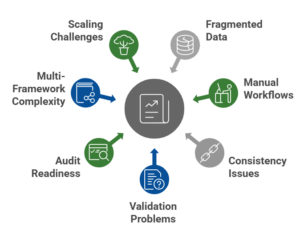
Even when companies understand what “good” looks like, they hit operational roadblocks:
- Fragmented Data and Manual Workflows
Climate scenario analysis draws on emissions data, asset locations, financials, supply chain information, and external climate data. When this sits in silos—emails, spreadsheets, disparate systems—the process becomes slow and error-prone.
How platforms like Ecoactive help:
- Centralised data management: bring ESG, climate, and financial data into one controlled environment.
- Single source of truth: avoid version conflicts and shadow files during scenario runs and reporting.
- Consistency, Validations, and Audit Readiness
Scenario analysis must withstand investor scrutiny and assurance processes. Missing values, inconsistent assumptions, or undocumented overrides damage credibility.
Digital solution angle:
- In-built validations catch outliers, missing data, or inconsistent units early.
- Full audit trail tracks who changed what and when—essential for internal controls and external assurance.
- Multi-Framework Reporting Complexity
The same climate scenario insights must often be reported under ISSB S2, ESRS E1, and local requirements. Manually mapping one analysis to multiple disclosures is time consuming and risky.
Multi-framework support in platforms:
- Central scenario outputs that can be tagged to multiple frameworks and disclosure points.
- Digital taxonomy alignment and XBRL-ready structures that streamline regulatory submissions and digital reporting.
- Scaling Beyond One-Off Projects
Many organisations run a one-time scenario analysis with consultants and struggle to update it annually or integrate it into ongoing planning.
Where automation and AI come in:
- Automation and AI-supported workflows can pre-populate disclosures, suggest data linkages, and help draft narrative sections based on structured inputs.
- Integrated workflows connect data collection → scenario modelling → internal reviews → final ESG/integrated report, reducing manual friction and dependence on ad-hoc files.
Platforms such as Ecoactive are built to enable this end-to-end journey: from raw data to decision-useful, multi-framework-aligned climate disclosures—without turning every reporting cycle into a reinvention exercise.
Turning Scenario Insights Into Stakeholder Confidence
Stakeholders don’t just want to see that scenarios were “considered.” They want evidence that insights are driving decisions. Strong ESG and integrated reports therefore:
- Explain how scenario results influenced strategy (e.g., exiting high-risk geographies, pivoting product mix).
- Link to transition plans—targets, decarbonisation levers, and capex/opex commitments.
- Show how climate risk is integrated into governance, including board oversight and management responsibilities.
- Demonstrate a continuous improvement mindset, committing to refining assumptions and expanding coverage over time.
When scenario analysis is embedded in a robust digital reporting backbone, companies can confidently show that:
They understand their climate risks.
They are acting on them.
They can explain and evidence these actions consistently, year after year.
That is the foundation of trust—with investors, regulators, customers, and employees.
The Road Ahead: From Uncertainty to Resilience
Climate uncertainty is here to stay. The organisations that will thrive are those that treat scenario analysis not as a reporting burden but as a strategic asset. By combining robust methodologies with modern ESG platforms—centralised data, integrated workflows, validations, AI, and multi-framework support—companies can turn complex climate futures into clear decisions and credible disclosures.
For sustainability, finance, and compliance leaders across the US, UK, and India, the message is clear:
Now is the time to upgrade your climate risk and reporting infrastructure so your next ESG or integrated report doesn’t just describe the past—but demonstrates resilience for the future.
To read more blogs click here.