More frameworks. More contributors. Same spreadsheet.
More jurisdictions. More assurance scrutiny. Same email chain.
Financial and ESG reporting converging into one obligation. Still managed as two separate documents.
That mismatch is the actual story of disclosure management today. The requirements have scaled. The tooling underneath them has not. Numbers and narrative drift out of sync mid-cycle. Changes ripple through a report without anyone tracking the full blast radius. Audit evidence gets assembled after the fact, reconstructed from inboxes and document versions, instead of existing because it was captured the moment the work happened.
EcoActive believes disclosure management was never meant to be a document production exercise. It’s a governed, interconnected process — and we think the only way to manage it with confidence at scale is with AI that’s purpose-built for regulated reporting, not retrofitted onto it.
AI Built for Reporting, Not Adapted to It
EcoActive’s AI strategy didn’t begin with Generative AI. The foundation goes back over a decade of investment in artificial intelligence, machine learning, automation, and regulatory technology — including AI-related patents dating to 2015, well before Generative AI entered the mainstream conversation.
We think that history matters, because regulated reporting asks something different of AI than most use cases do. It’s not enough to generate plausible text. The system needs to understand how numbers and narrative relate to each other, recognize when a change is about to become a filing risk, and leave behind a trail of evidence as a byproduct of doing the work — not as an afterthought. That’s where EcoActive’s agents come in. Rather than waiting for a prompt, they actively monitor the reporting process, make decisions inside clearly defined guardrails, and coordinate action across the workflow — with a person always in the loop. We’ve paired that decade of reporting-specific groundwork with the latest advances in Generative AI, rather than treating either one as the whole answer on its own.
What EcoActive’s AI Agents Actually Do
EcoActive’s native AI is the foundation: a decade of reporting-specific intelligence, governance, and regulatory expertise built into the platform itself. Sitting on top of that foundation, a set of Agentic AI agents do the active work — each one assigned to a specific part of the reporting workflow, watching continuously rather than waiting to be asked. Here’s what they help you do:
- Keep the report connected: A connection agent links numbers, narrative, tables, and disclosures throughout the cycle. When a figure changes, it already knows every section that references it — nothing drifts quietly out of sync.
- Understand what a change actually means: An impact agent reasons through consequence — not just that something moved, but which approvals it invalidates, who needs to look again, and what’s now at risk.
- Orchestrate the workflow, not just the data: A workflow agent monitors completeness, coordinates reviews, tracks approvals, and surfaces issues before they become filing problems.
- Validate continuously, not at the finish line: A validation agent catches inconsistencies, misalignments, and missing disclosures while there’s still time to fix them.
- Flag risk early: The same validation layer surfaces gaps in completeness and mismatches between narrative and numbers before they reach review.
- Assist with drafting, never with deciding: Generative AI supports narrative and commentary grounded in governed data — every output still passes through human review before it’s part of the report.
- Keep everything traceable: A traceability agent maintains the link between every published figure and its source, with no broken links or unexplained adjustments for an auditor to untangle.
Why Document-Centric Approaches Cannot Keep Up
Most disclosure management tools were built around Word and Excel, back when reporting was simpler. As the requirements became multi-framework, cross-functional, audit-sensitive, and machine-readable, those tools weren’t redesigned — they were extended. The same handful of problems keep showing up every cycle as a result. EcoActive’s essential disclosure platform features guide goes deeper on what a modern alternative needs to cover:
- Silent drift. A figure is updated in one place. Without connected intelligence, every note, commentary paragraph, and cross-reference that cites it has to be found and updated by hand. Some get missed.
- Invisible impact. A review comment touches multiple sections, and without a system that understands those relationships, finding every instance is mostly guesswork.
- Expanded review cycles. When nobody has full visibility into what changed and what it affected, large sections of the report get re-reviewed “just to be safe.”
- Fragmented audit evidence. Approvals and reviews scattered across email and document versions make a defensible audit trail difficult to reconstruct — sometimes impossible.
We don’t think this comes down to teams working inefficiently. It’s that the burden of managing complexity has landed on people instead of systems. That’s the part EcoActive’s AI is built to take back.
How the Platform Governs the Full Disclosure Lifecycle
EcoActive holds the complete disclosure workflow in one governed environment, from data ingestion through to compliant digital filing — with reporting teams, legal counsel, external auditors, and the board all working inside the same system.
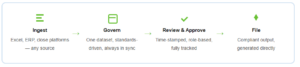
The applicable standards and taxonomy shape what gets collected and where it needs to appear, so data flows once from source into primary statements, comparative periods, notes, and commentary — referenced everywhere it’s needed, never re-entered. When something changes, every reference updates and every affected section gets flagged. By the time a report is approved, what the regulator receives is exactly what the team signed off on — for mandates that require XHTML with Inline XBRL, such as ESEF filings in the EU, that output is powered by Ez-XBRL, generated from the same governed dataset rather than built separately. As financial and sustainability reporting converge under frameworks like the ISSB’s global baseline standards, that single governed dataset becomes the thing holding both sides of the report together.
What You Gain
Control over change
Every revision is tracked, its impact surfaced, and affected sections flagged for review automatically — at any point in the cycle.
Reports that stay aligned
Numbers and narrative remain connected throughout the cycle. Silent drift between figures, disclosures, and commentary is eliminated.
An audit trail that builds itself
Evidence, approvals, and decisions are captured as part of the reporting process — not assembled afterward when the auditor asks for them.
Confident sign-off
Every stakeholder works within a governed process with clear ownership, deadlines, and accountability throughout.
Defensibility under scrutiny
Every figure traces back to source. Every decision is documented. The governed process can be explained and defended to regulators and auditors.
A process that scales
As regulatory requirements evolve, the platform absorbs the complexity — so manual effort does not increase with each reporting cycle.
Where We Land
Disclosure management was never just a filing exercise to begin with — it’s dozens of people, multiple frameworks, and constant revision, all needing to land somewhere accurate and defensible. We don’t think that’s solved by writing reports faster. It’s solved by something watching the process closely enough that drift, gaps, and untracked changes stop being a normal part of the cycle. Whether that’s a bank managing prudential and financial disclosures in parallel, or a fast-growing company preparing for its first complex reporting cycle, the underlying need is the same.
That’s the bet EcoActive has made with Agentic AI: not a tool that replaces judgment, but one that clears away everything that shouldn’t have needed a person’s attention in the first place.
See how EcoActive’s Native AI governs your disclosure process end to end.