Over the past decade, net-zero commitments have become the hallmark of corporate climate ambition. Thousands of companies worldwide have pledged to reach net-zero emissions by 2050 or sooner. Yet investors, regulators, and stakeholders are increasingly asking a tougher question: How exactly will you get there?
The era of high-level promises is ending. Companies are now expected to present credible, science-based climate transition plans—with clear roadmaps, interim targets, operational levers, and evidence of capital allocation. Frameworks such as IFRS S2, ESRS E1, and GRI climate disclosures are pushing organisations to demonstrate not just ambition, but execution.
For sustainability, finance, and compliance leaders, this shift marks a fundamental change in ESG reporting. Net-zero is no longer a narrative statement; it is a strategic transformation programme that must be measurable, governed, and auditable.
Why Climate Transition Plans Matter Right Now
Three forces are driving the demand for credible transition plans.
First, regulation is tightening. Climate-related disclosures are moving from voluntary guidance to mandatory reporting. IFRS S2 requires companies to disclose transition plans aligned with climate scenarios, while ESRS E1 emphasises detailed decarbonisation strategies and progress tracking.
Second, investor expectations have matured. Institutional investors now scrutinise whether corporate climate commitments are supported by realistic pathways. They want evidence that companies have mapped emissions reduction levers, evaluated climate risks, and aligned capital expenditure with transition goals.
Third, physical and transition risks are accelerating. Energy volatility, supply-chain disruptions, carbon pricing, and climate-related extreme events are reshaping business models. Companies that fail to plan their transition risk not only regulatory scrutiny but also financial instability.
In short, a credible transition plan has become a strategic resilience tool as much as a sustainability disclosure requirement.
The Gap Between Net-Zero Promises and Real Pathways
Despite widespread commitments, many companies still struggle to translate climate ambition into operational action. Common challenges include:
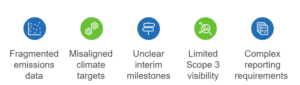
- Fragmented emissions data spread across facilities, suppliers, and business units
- Difficulty aligning climate targets with financial planning and capital allocation
- Lack of clarity on interim milestones between today and a 2050 goal
- Limited visibility into Scope 3 emissions across value chains
- Complex reporting requirements across multiple frameworks and jurisdictions
The solution lies in developing structured, science-based pathways supported by robust data systems and governance processes.
Building a Credible Climate Transition Plan
A strong transition plan typically includes five essential components.
1. Science-Based Targets and Interim Milestones
A credible net-zero pathway begins with targets aligned to climate science. Many companies use the Science Based Targets initiative (SBTi) to validate emissions reduction trajectories.
However, long-term targets alone are insufficient. Organisations must establish interim milestones—for example, emissions reductions by 2025, 2030, and 2040. These milestones enable progress tracking and accountability.
2. Clear Decarbonisation Levers
Transition plans must identify the operational levers that will drive emissions reductions. These often include:
- Energy efficiency improvements across facilities
- Renewable energy procurement and on-site generation
- Electrification of operations and fleets
- Process innovation and product redesign
- Supply-chain engagement and low-carbon sourcing
Mapping these levers allows companies to translate climate targets into practical implementation strategies.
3. Capital Allocation and Financial Integration
Investors increasingly evaluate whether companies’ capital expenditure aligns with their climate ambitions. A credible transition plan should demonstrate:
- Budget allocation for decarbonisation initiatives
- Investment in low-carbon technologies and infrastructure
- Financial implications of carbon pricing scenarios
Integrating sustainability with financial planning ensures climate strategy is embedded within core business decision-making.
4. Climate Scenario Analysis
Climate transition plans must also account for uncertainty. Scenario analysis—aligned with TCFD and IFRS S2 guidance—helps companies evaluate how their strategies perform under different climate futures.
For instance, a company may analyse how a 1.5°C transition scenario with higher carbon prices affects operating costs, demand patterns, or technology adoption timelines.
5. Transparent Monitoring and Reporting
Finally, companies must establish systems to monitor progress and disclose results transparently. This requires structured ESG data collection, governance processes, and integrated reporting frameworks.
Without reliable data infrastructure, even well-designed transition plans can struggle to maintain credibility.
The Data and Reporting Challenge
As climate transition planning becomes more rigorous, reporting complexity increases.
Organisations must consolidate emissions data across global operations, align disclosures with multiple frameworks, and produce audit-ready reports for regulators and investors. Sustainability teams often rely on fragmented spreadsheets and manual processes, which makes tracking progress against transition pathways difficult.
Additionally, frameworks such as IFRS S2, ESRS, and GRI require consistent definitions, structured datasets, and digital reporting formats. As digital filings and structured data standards such as XBRL gain traction, manual reporting approaches are becoming unsustainable.
This is where technology plays a crucial role.
Enabling Credible Transition Plans Through Digital ESG Platforms like EcoActive
Modern ESG platforms are increasingly helping companies manage the complexity of climate transition planning and reporting.
Platforms such as Ecoactive enable organisations to centralise climate and sustainability data across departments and geographies, creating a single source of truth for emissions, targets, and transition initiatives.
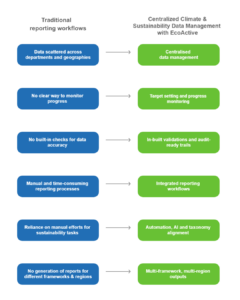
- Centralised data management. A single, governed backbone where GHG emissions, energy, water, land-use, forests, social metrics and financial data can be ingested via APIs, templates and integrations. This is critical when climate- and nature-linked finance depends on consistent numbers across entities and geographies.
- Target setting and progress monitoring. Organisations can define climate and sustainability targets, map interim milestones, and track progress against baselines over time. This helps move transition plans beyond aspiration by enabling continuous monitoring of performance against net-zero pathways, operational goals, and reporting commitments.
- In-built validations and audit-ready trails. Automated checks (e.g., factor consistency, outlier detection, duplicate entries) and full change logs make it easier to withstand assurance under ESRS, IFRS S1/S2 and GRI-based reporting.
- Integrated reporting workflows. Sustainability teams, finance, risk, legal and operations can collaborate in a single environment – linking climate finance, transition plans, physical risk assessments and nature metrics into one integrated report rather than parallel narratives.
- Automation, AI and taxonomy alignment. AI-assisted mapping of disclosures to ESRS, GRI and IFRS S2; digital tagging for XBRL/iXBRL; and automated generation of draft tables and narrative sections reduce the friction of multi-framework reporting while keeping human oversight in the loop.
- Multi-framework, multi-region outputs. One underlying dataset can support EU CSRD/ESRS reports, SEBI BRSR filings, UK transition plans, US investor questionnaires and voluntary frameworks – essential for multinationals operating across the US, UK and India.
Rather than simply reporting emissions, companies can use these insights to inform decision-making and accelerate decarbonisation efforts.
From Climate Commitments to Climate Credibility
The transition to a low-carbon economy is no longer a distant vision—it is a business reality unfolding today. Regulators, investors, and society expect companies to move beyond aspirational pledges and demonstrate credible, science-based pathways to net zero.
Organisations that succeed will be those that integrate climate strategy into core operations, align capital allocation with decarbonisation goals, and establish transparent systems for tracking progress.
In this new era of climate accountability, data-driven reporting and robust digital infrastructure are essential enablers of credible transition plans.
Net-zero commitments are important. But what truly matters now is the road-map that turns those commitments into measurable action.
Follow EcoActive for more insights on modern ESG reporting.