Singapore has opened a public consultation on draft Sustainability Disclosure Standards aligned with IFRS S1 and IFRS S2. The proposals explain how the ISSB Standards would be adapted for Singapore, which requirements would be mandatory and how they would operate alongside the country’s phased climate-reporting roadmap.
The Accounting and Corporate Regulatory Authority’s Interim Sustainability Standards Committee has launched a public consultation on the draft Singapore Sustainability Disclosure Standards. The consultation runs from 27 July to 25 October 2026 and invites feedback from companies, investors, assurance providers, professional bodies and other stakeholders.
What Is Singapore Proposing?
Singapore is proposing two local sustainability disclosure standards based on the International Sustainability Standards Board’s IFRS Sustainability Disclosure Standards:
- SFRS S1 – General Requirements for Disclosure of Sustainability-related Financial Information, based on IFRS S1
- SFRS S2 – Climate-related Disclosures, based on IFRS S2
IFRS S1 establishes general requirements for disclosing financially material sustainability-related risks and opportunities. IFRS S2 focuses specifically on climate-related risks and opportunities.
Under Singapore’s climate-first approach, only SFRS S2 is proposed to be mandatory for companies covered by the country’s climate-reporting roadmap. SFRS S1, which addresses sustainability-related risks and opportunities beyond climate, would remain voluntary.
The proposed standards do not establish an entirely new reporting roadmap. Instead, they would provide the local disclosure framework supporting climate-reporting and assurance obligations introduced through Singapore’s regulatory system.
Singapore’s Reporting Timelines Were Adjusted in August 2025
Singapore’s climate-reporting roadmap was developed by ACRA and Singapore Exchange Regulation, with requirements taking effect in phases according to company type, listing status and market capitalisation.
In August 2025, ACRA and SGX Regulation extended several climate-reporting timelines to give companies more time to develop their data systems, internal reporting capabilities and assurance readiness. The current consultation therefore reflects the adjusted implementation roadmap rather than Singapore’s original reporting schedule.
Key Requirements Proposed Under the Singapore Sustainability Disclosure Standards
1. SFRS S2 Would Operate as a Standalone Climate Standard
Climate-relevant requirements from SFRS S1 would be incorporated into an appendix to SFRS S2. This would allow companies subject to mandatory climate reporting to apply SFRS S2 without having to navigate SFRS S1 separately. SFRS S1 would remain available for organisations that voluntarily choose to report on broader sustainability-related risks and opportunities.
The proposed structure is intended to make Singapore’s climate-first reporting approach clearer and more practical for preparers.
2. Climate Disclosures Would Be Published with Financial Statements
IFRS S1 includes a first-year transition relief that may allow companies to publish sustainability-related disclosures after their financial statements. Singapore does not propose adopting this timing relief.
Companies would instead be required to publish their climate-related disclosures at the same time as their financial statements. The objective is to strengthen the connection between financial and climate information and ensure that material information reaches report users in a timely manner.
This requirement may increase the need for finance and sustainability teams to manage their reporting processes through a unified financial and ESG reporting environment, with aligned data collection, review, approval and publication timelines.
3. Scope 3 Relief Would Continue for Companies Not Subject to Mandatory Reporting
IFRS S2 provides first-year relief that allows companies to exclude Scope 3 greenhouse gas emissions during their first reporting period. Under the Singapore proposal, this would become an ongoing relief for companies that are not subject to mandatory Scope 3 reporting under Singapore’s phased implementation roadmap.
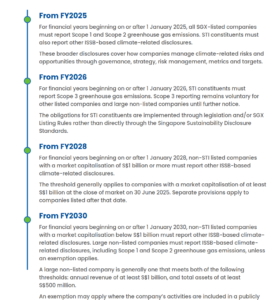
Scope 3 reporting is mandatory for Straits Times Index constituents from FY2026. It remains voluntary for other listed companies and large non-listed companies until further notice.
Importantly, the Scope 3 mandate itself would not be imposed directly through the Singapore Sustainability Disclosure Standards. The consultation clarifies that Scope 3 reporting obligations are established through applicable legislation and/or SGX Listing Rules.
The standards would instead determine how the Scope 3 transition relief applies based on whether a company is subject to those separately established obligations. In practical terms, the standards define how climate information should be reported, while legislation and SGX Listing Rules determine which companies must report and when.
Companies preparing their emissions processes can also explore how structured systems support the collection and management of Scope 1, Scope 2 and Scope 3 emissions data.
4. The Climate-First Transition Relief Would Not Be Needed
IFRS S1 allows first-time reporters to focus initially on climate-related disclosures before expanding into broader sustainability reporting. Singapore does not propose adopting this relief because its local framework already makes SFRS S2 mandatory while keeping broader SFRS S1 reporting voluntary.
Companies subject to mandatory reporting would therefore begin with climate-related disclosures under SFRS S2 without being required to report on every sustainability-related risk and opportunity covered by SFRS S1.
5. Companies Would Need to State Compliance Explicitly
Companies applying mandatory SFRS S2 reporting would be required to include an explicit and unreserved statement of compliance with the standard. The proposed requirement is intended to reinforce accountability and provide users with clarity about the reporting framework used to prepare the company’s climate disclosures.
Companies would therefore require controlled processes for assessing whether all applicable requirements have been addressed before making the compliance statement.
6. Use of SASB Materials Would Be Voluntary
The ISSB Standards require companies to refer to and consider the applicability of Sustainability Accounting Standards Board materials when identifying industry-specific risks, opportunities and disclosure metrics. Under the Singapore proposal, companies would be permitted—but not required—to refer to the SASB Standards and the Industry-based Guidance on Implementing IFRS S2.
This adjustment would give companies greater flexibility while the industry-based materials continue to evolve.
Companies operating across jurisdictions can review how ISSB, SASB, ESRS and other ESG reporting frameworks relate to their wider disclosure obligations.
Singapore Sustainability Reporting Timeline
The phased roadmap distinguishes between STI constituents, larger non-STI listed companies, smaller non-STI listed companies and large non-listed companies. Companies can use ACRA’s official sustainability reporting and assurance timeline to determine when specific requirements become applicable.
When Will External Assurance Become Mandatory?
Singapore is also introducing external limited assurance over Scope 1 and Scope 2 greenhouse gas emissions. Under the adjusted roadmap, listed companies will require limited assurance from FY2029, and large non-listed companies will require limited assurance from FY2032.
Companies must engage an eligible assurance provider, such as an audit firm registered with ACRA or an appropriately accredited testing, inspection or certification organisation. These requirements mean companies will need more than final reported figures. They will also need documented methodologies, controlled data processes, supporting evidence and traceable review and approval records.
What Do the Proposed Standards Mean for Companies?
The proposed Singapore Sustainability Disclosure Standards provide greater clarity on how ISSB-aligned climate reporting would be applied in Singapore. For reporting teams, SFRS S2 would require information about how climate-related risks and opportunities affect governance and oversight, business strategy, risk-management processes, climate-related metrics and targets, greenhouse gas emissions, and financial planning and decision-making.
Companies should also distinguish between the standards and the regulatory instruments that establish mandatory reporting. The standards would define what compliant climate disclosures should contain. Legislation and SGX Listing Rules would determine which organisations are required to report, the applicable start date and specific obligations such as mandatory Scope 3 reporting.
Managing these interconnected requirements may require a more structured ESG disclosure management process covering data collection, framework mapping, narrative preparation, validation, approvals and supporting evidence.
How Should Companies Prepare for SFRS S2?
Companies preparing for Singapore’s ISSB-aligned climate-reporting requirements should consider mapping existing climate disclosures against SFRS S2, identifying applicable reporting and assurance timelines, and establishing ownership for climate-related data and disclosures. They should also connect climate risks with financial assumptions and reporting, strengthen Scope 1 and Scope 2 data controls, and prepare Scope 3 processes where reporting will become mandatory.
Further steps include documenting calculation methods, assumptions and judgements, retaining evidence to support reported information, aligning financial and sustainability reporting calendars, introducing structured review, validation and approval workflows, and preparing emissions information for external assurance.
Because climate disclosures would need to be published with the financial statements, companies may need to bring sustainability reporting activities forward and integrate them more closely with the financial close and annual-reporting process. An ESG reporting platform can help centralise information, coordinate contributors and support repeatable reporting across evolving sustainability frameworks.
How EcoActive Supports ISSB-Aligned Sustainability Reporting
EcoActive helps organisations manage financial and sustainability disclosures within a unified, governed reporting environment. The platform enables reporting teams to collect climate data through structured workflows, assign ownership, manage supporting evidence and maintain a complete audit trail across the reporting process.
EcoActive supports:
EcoActive’s native AI and impact-aware change management help teams identify reporting gaps, understand how updates affect connected information and maintain alignment when data or disclosures change late in the reporting cycle.
Prepare for Singapore’s evolving sustainability disclosure requirements with connected, governed and audit-ready reporting.
Manage ISSB-aligned climate disclosures with greater control and confidence.
Frequently Asked Questions
What are the Singapore Sustainability Disclosure Standards?
The Singapore Sustainability Disclosure Standards are proposed local standards based on the ISSB’s IFRS S1 and IFRS S2. They would comprise SFRS S1 for general sustainability-related financial disclosures and SFRS S2 for climate-related disclosures.
Is SFRS S1 mandatory in Singapore?
No. Under the consultation proposal, SFRS S1 would remain voluntary because it covers broader sustainability-related risks and opportunities beyond climate.
Is SFRS S2 mandatory in Singapore?
SFRS S2 is proposed as the mandatory climate-disclosure standard for companies covered by Singapore’s phased climate-reporting roadmap. The applicable reporting date depends on the company’s listing status, size and market capitalisation.
Does SFRS S2 itself make Scope 3 reporting mandatory?
No. The consultation states that mandatory Scope 3 reporting requirements are established through legislation and/or SGX Listing Rules rather than directly through the Singapore Sustainability Disclosure Standards.
Who must report Scope 3 emissions in Singapore?
Scope 3 greenhouse gas emissions reporting is mandatory for STI constituents from FY2026. It remains voluntary for other listed companies and large non-listed companies until further notice.
Were Singapore’s climate-reporting timelines extended?
Yes. ACRA and SGX Regulation adjusted several implementation timelines in August 2025 to give companies more time to develop climate-reporting capabilities.
When does the consultation close?
The public consultation closes on 25 October 2026.